
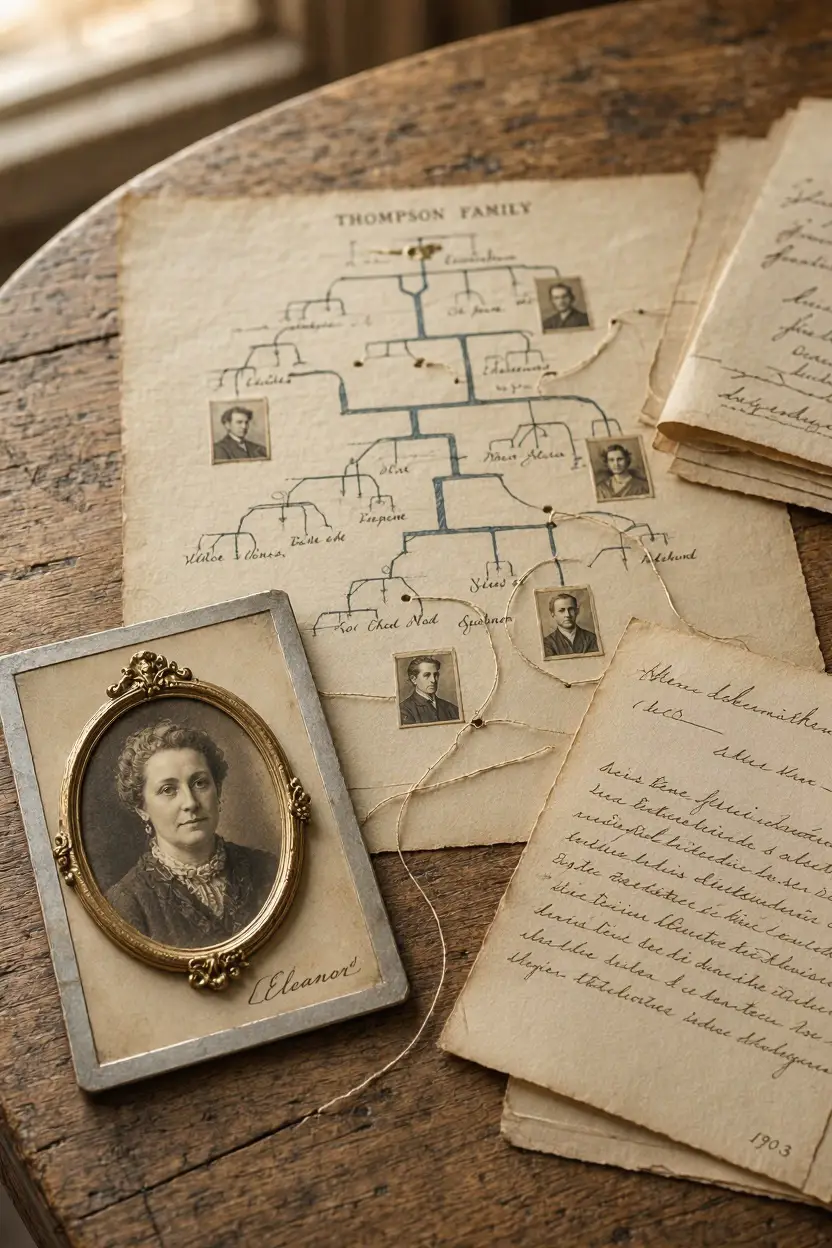
Every family has certain stories that seem to surface again and again—the grandmother who refused to give up, the uncle who took a chance no one expected, or the quiet habit that somehow traveled from one generation to the next. For years, these stories may feel like separate pieces of family history. Then one day, we notice the thread connecting them. That thread is what I think of as an ancestral blueprint: the hidden structure beneath the stories, choices, and emotional patterns that echo across generations.
Once I began looking at family stories this way, I found that three pieces often brought a pattern into focus:
- An ancestor
- A turning point
- A trait pattern
Together, these pieces can act like the load-bearing beams of a family story. They do not explain everything about a person or a lineage, but they can help us see connections that were easy to miss before.
Let’s walk through how to use them.
Step 1: Choose One Ancestor
Start small. A single person gives you a clearer place to begin than an entire family tree filled with names, dates, and competing stories.
Pick one ancestor who:
- Stands out in family stories
- Represents a strong trait (kindness, stubbornness, resilience)
- Experienced a moment people still talk about
- Or simply feels interesting to you
This isn’t about choosing the “most important” ancestor. It’s about choosing one person whose life left a noticeable imprint.
Example: Your grandmother, who was known for her fierce independence.
Step 2: Identify Their Turning Point
A turning point is a moment when their life changed direction — a decision, event, or crisis that shaped who they became.
Turning points draw us into an ancestor’s life because they give us a scene we can picture: a departure, a loss, a risk, or a decision after which nothing was quite the same.
Common turning points include:
- Immigration
- Marriage or divorce
- Loss
- Career shifts
- Survival moments
- A bold decision that changed everything
Example: Your grandmother left home at 17 to work in another state — a choice that defined her independence.
Step 3: Trace the Trait Pattern
This is where the blueprint reveals itself.
Ask:
- What trait emerged from that turning point?
- Who else in the family carries that trait?
- How has it evolved across generations?
- Does it show up as a strength, a wound, or both?
Trait patterns often look like:
- Independence
- Perfectionism
- Caretaking
- Stoicism
- Creativity
- Conflict avoidance
- Resilience
- Risk‑taking
Imagine a grandmother who left home at 17 to work in another state. Perhaps the family remembers that choice as the moment she became fiercely independent. Years later, her daughter prides herself on never needing help. In the next generation, that same self-reliance may appear as competence and determination—but also as the exhaustion of carrying everything alone. What began as one young woman’s survival strategy has become both a family strength and a burden.
Suddenly, the blueprint is visible.
Putting It All Together: Your 3‑Step Blueprint Starter
Ancestor → Turning Point → Trait Pattern
- Ancestor:
Grandmother - Turning Point:
Leaving home at 17 - Trait Pattern:
Independence passed down as both strength and burden
Seen this way, a family history is no longer only a collection of records and remembered events. It becomes a living pattern—one that can help us understand what our ancestors carried, what they passed along, and what we may be ready to hold differently.
Why This Matters
When you understand your ancestral blueprint, you gain:
- Clarity
— your family story becomes organized - Compassion
— you see why people became who they are - Connection
— traits feel inherited, not random - Choice
— you can continue or transform the pattern
Your family story becomes a map, not a mystery.
A Gentle Invitation
Choose one ancestor who has been on your mind. Look for the moment when that person’s life changed direction, then follow the trait that grew from it. Where else does it appear in your family? Where does it appear in you? You may not find a perfect answer, and that is all right. Sometimes simply noticing the pattern is enough to help a familiar family story reveal something new.
You’ll be surprised how quickly the blueprint appears.
0 Comments