
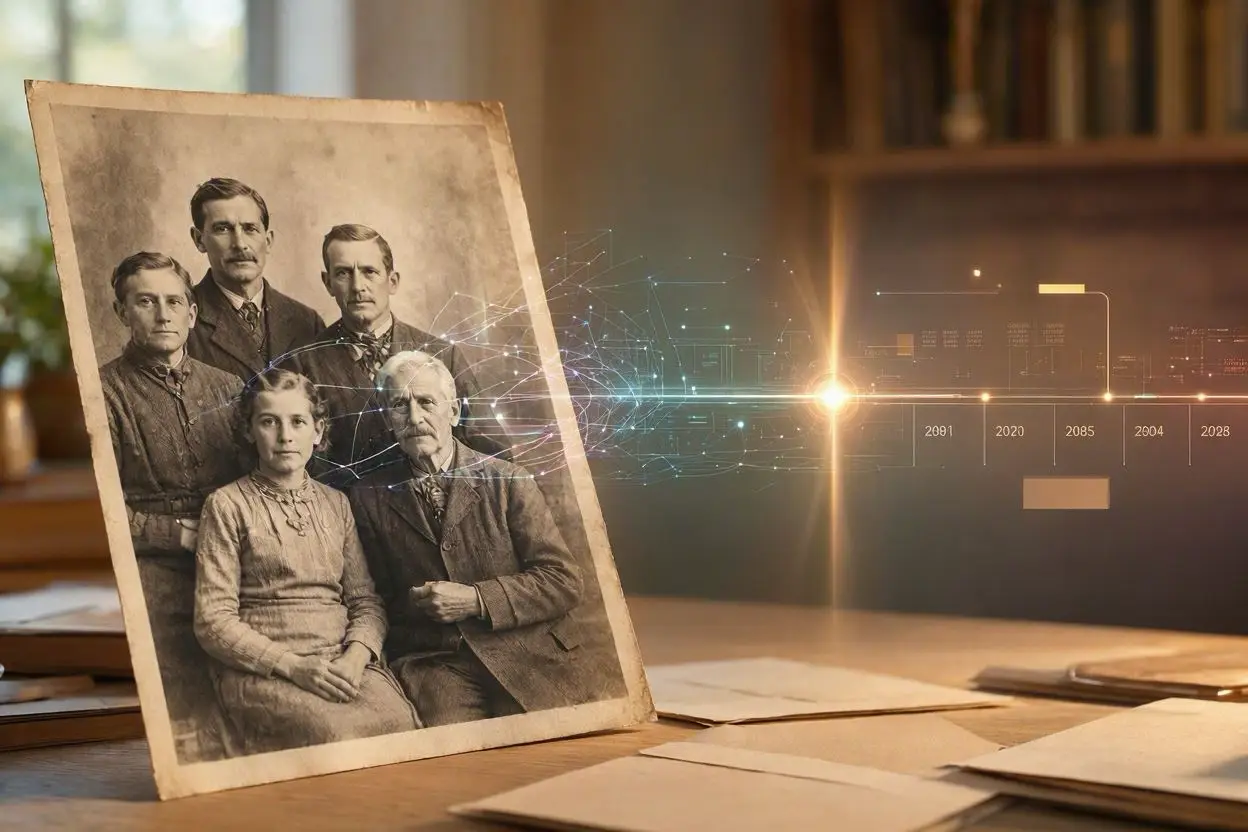
How AI Helps Reveal the Moment an Ancestor’s Life Changed
Every ancestor has a moment when life takes a turn—sometimes quietly, sometimes in a way that changes everything. Maybe it was the year they enlisted, the season they packed up and moved, the day they lost a child, or the moment a family secret settled into silence. Whatever the event, these turning points don’t stop with one person. They ripple through generations, shaping patterns, fears, strengths, and the stories families keep telling—or avoid telling altogether.
But here’s the challenge: Most people don’t know their ancestor well enough to immediately identify that turning point. The records are thin. The stories are incomplete. The silences are loud.
This is where AI becomes a powerful ally—not to replace human intuition, but to illuminate possibilities we might overlook.
Why Turning Points Matter in Genealogy
A turning point is the emotional hinge of a life story. It’s the moment where:
- behavior shifts
- a pattern begins
- a myth forms
- a wound takes root
- a strength emerges
- a generational echo starts reverberating
If you can identify the turning point, you can understand the person. If you can understand the person, you can understand the lineage.
How AI Helps Identify Turning Points
AI doesn’t magically “know” your ancestor. But it can analyze what you have—timelines, documents, stories, gaps—and surface plausible turning points based on patterns, context clues, and historical norms.
Think of it as a Turning Point Detector.
1. Timelines: Spotting Abrupt Shifts
AI can scan a timeline and highlight moments where something changed suddenly:
- relocation
- disappearance from records
- change in occupation
- new household members
- shifts in naming patterns
- sudden religious or financial changes
Try this prompt: “Analyze this timeline and identify any events that might represent a major turning point in this ancestor’s life. Focus on abrupt changes, losses, relocations, or shifts in behavior.”
2. Documents: Reading Between the Lines
Historical documents often contain clues that hint at deeper emotional or practical shifts:
- military enlistment
- immigration papers
- probate files
- marriage or divorce records
- land purchases or foreclosures
- court cases
AI can help interpret these documents in context, suggesting what might have changed and why.
Prompt idea: “Based on these documents, what life events might have significantly changed this ancestor’s trajectory?”
3. Stories: Extracting Emotional Clues
Family stories—especially the ones told with emotion, repetition, or contradiction—often contain the seeds of a turning point.
AI can help identify:
- narrative inconsistencies
- emotional hotspots
- missing pieces
- repeated themes
- protective silences
Prompt idea: “Here is a family story. Identify any emotional or narrative clues that suggest a major turning point in this ancestor’s life.”
4. Silences: Inferring What’s Missing
Silence is a clue. Missing years, missing children, missing explanations—these often point to a turning point that was too painful or too complicated to record.
AI can help generate possibilities without claiming certainty.
Prompt idea: “Given these gaps in the record, what plausible turning points might explain the missing information?”
Where The Ancestral Mirror Fits In
Once AI helps surface potential turning points, The Ancestral Mirror provides the interpretive framework to understand what those moments meant—and how they echo through the lineage.
Here’s how readers can use the book to deepen their exploration:
Chapter 1 — The Mirror
AI becomes a reflective tool, showing possibilities rather than definitive answers.
Chapter 2 — The Stories We Inherit
Turning points often hide inside myths, silences, and family lore.
Chapter 3 — The Pattern Lens
Once the turning point is identified, patterns become visible across generations.
Chapter 4 — The Truthful Ancestor
This chapter helps readers humanize the ancestor behind the event.
Chapter 5 — The Shadow Archive
Many turning points are traumatic; this chapter helps readers approach them gently.
Chapter 6 — The Resilient Line
Turning points can also reveal strengths, gifts, and brilliance.
Chapter 7 — What the Death Records Don’t Say
Death records often hint at earlier turning points.
Chapter 8 — The Tree of Echoes
Trace how the turning point reverberates through descendants.
Chapter 9 — Reading Between the Lines
AI helps interpret documents for subtle clues.
Chapter 10 — The Ethical Genealogist
A reminder: AI offers possibilities, not verdicts.
Chapter 11 — Writing the Honest Family Story
Turning points are the spine of narrative.
Chapter 12 — Lineage Alchemy
Turning points often become identity-shaping forces.
Chapter 13 — Healing the Line
Understanding the turning point is the first step toward healing its echo.
Chapter 14 — Becoming a Good Ancestor
Once you understand the turning point, you can choose what to carry forward—and what to release.
Closing Reflection
AI doesn’t replace intuition, empathy, or human storytelling. But it does help you see the moment your ancestor’s life changed—the moment that shaped your lineage in ways you’re still feeling today.
Finding the turning point is where compassion begins. It’s where understanding deepens. It’s where healing becomes possible.
And with AI as your companion, you don’t have to navigate those shadows alone.
0 Comments