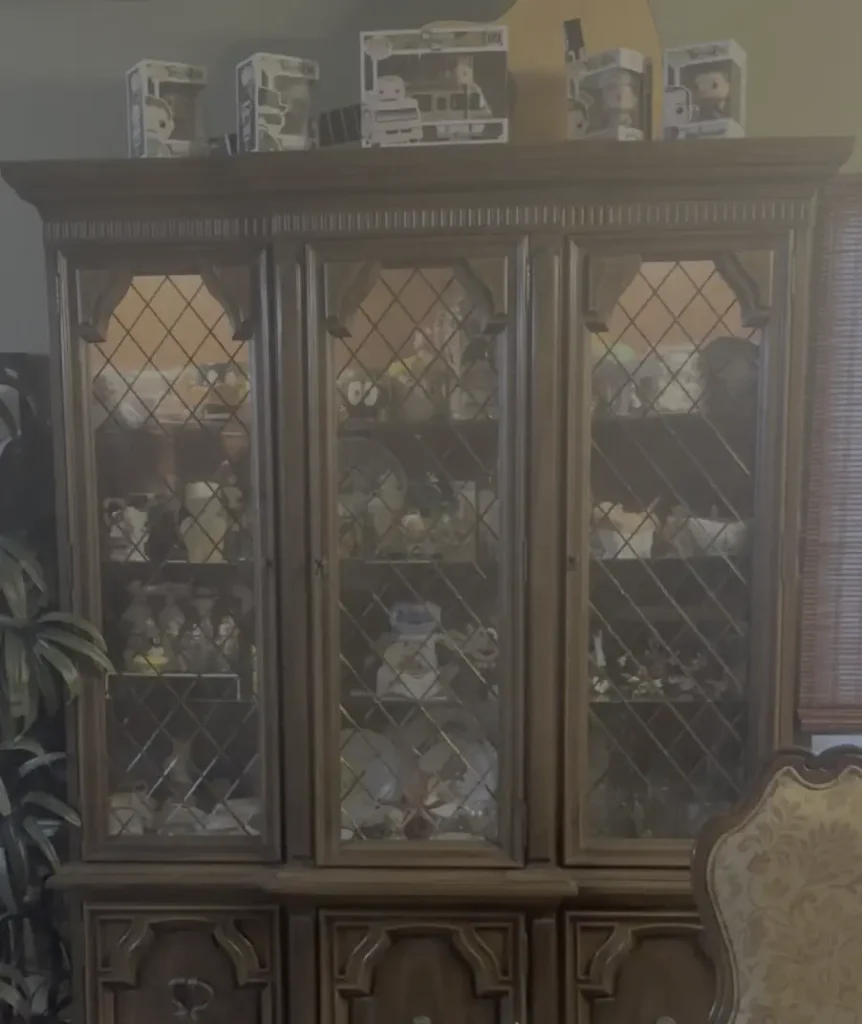
A china cabinet filled with family heirlooms.
When we hear the word heirloom, most of us picture something locked behind glass: a diamond ring, a set of fine china, or a silver pocket watch passed down with ceremony.
Yet anyone who has ever sorted through the home of a parent or grandparent knows that those are rarely the things that stop us in our tracks.
More often, what catches in our throat is a splattered recipe card written in familiar cursive, a worn wooden spoon, a paperback with underlined passages, or a chipped ornament wrapped in faded tissue paper. Those objects wouldn't fetch much at an estate sale, and to a stranger, they might look like ordinary clutter. But to the people who know their history, they hold something far more valuable than gold: quiet, tangible proof of how someone we loved lived, worked, and cared for the people around them.
I happen to have an entire cabinet full of things like that.
It's a china cabinet.
There just isn't any china in it.
My China Cabinet Without the China
I inherited the cabinet from my mother-in-law. I'm not really a china person, so rather than filling it with dishes, its shelves hold a collection of small objects.
"Knickknacks" doesn't seem like the right word.
They're just...things.
There's a piggy bank.
A tiny doll.
A beer stein.
And, among all the family artifacts, a rubber Domino's Pizza Noid.
To someone walking through my house who didn't know any better, the contents might look like a rather random assortment of stuff that various people collected over the years.
But look underneath each object and there's something else.
A 3×5 card.
Each card explains what the object is, whom it belonged to, and something about why it was saved.
Under one piggy bank is a card identifying it as the beloved piggy bank of Jimmy Heath, born August 11, 1958, died February 3, 1973. He was killed by a drunk driver.
Suddenly, it isn't an old piggy bank.
It belonged to a boy.
It was something he loved enough that after his short life ended, someone who loved him kept it. Eventually it came down through the family, and now it sits in my cabinet.
Then there's the tiny doll.
Its card explains that James Heath bought it for Donna at an Indian trading station along Route 66 during the family's drive to California.
It's a tiny souvenir from an enormous journey.
The beer stein has its own story. Gust Pastis picked it up in Germany during his tour of duty after World War II.
And then there's the Noid.
For anyone who doesn't remember him, the Noid was the odd little advertising character once associated with Domino's Pizza.
Mine has absolutely no great historical significance.
Its 3×5 card explains that I received it during college when my pizza delivery took more than 30 minutes.
The pizza was free.
The Noid was free.
And somehow, decades later, he's in the family archive.
I love that.
Not because I think future generations will be fascinated by Domino's promotional merchandise, although you never know, but because that's how real family histories are built.
There are tragedies and wars and migrations.
There are love stories.
There are journeys across the country.
And there are late pizzas.
All of them become pieces of our lives.
What Makes Something an Heirloom?
The objects in that cabinet illustrate something I've come to believe very strongly:
The story is what transforms the object.
Imagine removing all those 3×5 cards.
A future descendant opens the cabinet.
There's an old piggy bank.
Why keep it?
There's a tiny doll of no apparent value.
Where did that come from?
An old beer stein. Was it someone's? Did they collect steins? Did somebody just buy it at a yard sale?
And why on earth did April keep a rubber Domino's Pizza Noid?
Without context, the objects become mysteries.
A generation later, they may become clutter.
And eventually, perfectly reasonably, someone throws them away.
Put the cards back underneath them and everything changes.
The piggy bank belonged to Jimmy.
The doll was purchased on Route 66 for Donna.
The beer stein came home from Germany with Gust.
The ridiculous rubber Noid was April's.
The objects haven't changed.
Our understanding of them has.
That's the difference between an old thing and a family artifact.
The Quiet Keepers of Family History
Once you start thinking this way, you begin noticing potential family history everywhere.
Not just in china cabinets.
It might be in the kitchen.
Think about an old recipe card. Maybe there's a grease stain in one corner. Someone crossed out an ingredient and substituted something else. Beside the amount of sugar is a handwritten note telling the cook to use less.
At first, it's simply a recipe.
But that handwriting changes it.
Someone made that dish often enough to adjust it.
Maybe generations of family members ate it without ever knowing the recipe had evolved.
The same is true of a mixing bowl, rolling pin, roasting pan or serving spoon that appeared at every family gathering.
Those things were witnesses to ordinary family life.
They were present for birthdays and holidays, but also for completely forgettable Tuesday evenings when somebody had to get dinner on the table.
Official records rarely tell us about Tuesdays.
Our things can.
Sometimes history is tucked between the pages
Books are another kind of accidental family archive.
A family Bible may hold names and dates, but an ordinary book can be just as revealing.
Someone underlined a particular passage.
A flower was pressed between two pages.
An old grocery list became a bookmark.
A newspaper clipping was tucked inside and forgotten.
There might be a letter, photograph, receipt or church bulletin hiding there for decades. The original outline for this article specifically called attention to these kinds of paper scraps and overlooked objects because they can reveal aspects of a person's life that formal records cannot.
That's what makes them fascinating.
Birth certificates, censuses and marriage records tell us about moments when our ancestors interacted with institutions.
The grocery list tells us what they needed on Thursday.
Sometimes that's the person we're actually looking for.
Genealogy Gives Us the Skeleton. Objects Give Us the Texture.
Genealogy is extraordinarily good at reconstructing relationships.
This person was the daughter of that person.
These two people married.
Their family lived here, then moved there.
They had these children.
Those facts create the structure of a life.
They're essential.
But they don't necessarily tell us what that life felt like.
What book sat beside the bed?
What did someone cook when everyone came home?
What did they grow in the garden?
What object did a child treasure?
What souvenir did a young man bring home from Germany?
What did one family member buy for another on the long drive to California?

Those are different kinds of information.
They give a life texture.
That distinction between the genealogical "skeleton" of someone's life and the texture preserved in physical objects was one of the central ideas in my original notes for this article.
And I think that texture matters more than ever now that so much family history is digital.
We can accumulate hundreds or even thousands of records without ever quite feeling that we know the human beings represented by them.
Then you hold something they held.
And the distance gets a little smaller.
The Ancestral Mirror in a China Cabinet
That's part of what fascinates me about family history and what eventually led me to write The Ancestral Mirror.
When we learn about the people who came before us, we're doing more than accumulating names and dates.
Sometimes we recognize patterns.
We notice similarities.
We understand why certain stories were repeated.
We discover why others were avoided.
And sometimes we simply recognize the shared humanity of someone who lived in a completely different time.
I think objects can become part of that mirror.
Not because there's anything mystical about them.
It's because they make people tangible.
The boy represented by a name and two dates once had a favorite piggy bank.
A man returning from Germany brought something home.
Someone traveling Route 66 saw a tiny doll and thought of Donna.
A college student ordered a pizza, waited too long for it, and ended up with a rubber Noid that somehow survived long enough to become an artifact.
Suddenly these aren't just names on a family tree.
They are people doing things.
And sometimes those tiny details create a connection that no official record can.
We Can't Save Everything
Of course, there is a practical problem with all this.
Families accumulate a tremendous amount of stuff.
We cannot save everything our parents owned, much less everything our grandparents and great-grandparents owned.
Nor should we.
Preserving family history doesn't require turning our homes into museums or leaving our children with boxes of unidentified possessions they're afraid to discard because “maybe it's important.”
Instead, I think we can ask a better question:
What story would disappear if this object disappeared?
Sometimes the answer will tell us that the physical object itself matters.
Sometimes we'll discover that we're really trying to save the memory attached to it.
If that's the case, we have options.
Take a photograph.
Write down the story.
Record someone talking about it.
Add it to your digital family archive.
And sometimes, yes, put the object in a china cabinet with a 3×5 card underneath it.
The point isn't necessarily to preserve the thing forever.
It's to keep the knowledge from disappearing accidentally.
Three Things You Can Do Right Now
You don't need to take on a giant archival project.
Start with one object.
1. Give it a story tag
Write down whose object it was and why it matters.
Include names and dates if you know them, but don't stop there.
Instead of:
Mary's mixing bowl.
Try:
This mixing bowl belonged to Mary. She used it for Sunday dinners, and her grandchildren remember helping her make biscuits in it.
That second version gives a future reader a person and a scene.
My own 3×5 cards aren't elaborate. That's precisely why the system works.
The planning notes for this article originally suggested a simple “story tag” with the owner's name, dates and a brief memory. My cabinet is effectively a collection of those story tags.
2. Photograph the object and its story
The physical item may not survive forever.
The photograph can give its story another way to travel forward.
Photograph the object clearly and capture its identifying information too. The original outline also suggested creating a digital record pairing the object with its written story.
And give the file a meaningful name.
Not:
IMG_4827.jpg
Something more like:
Jimmy_Heath_Piggy_Bank.jpg
That small decision could make an enormous difference to someone encountering the file years from now.
3. Ask one question while you still can
This may be the most important step of all.
If someone is still living who knows why an object matters, ask them about it.
You don't need an elaborate oral history setup.
Pick up the object and ask:
“Do you remember where this came from?”
Then listen.
With their permission, record them talking about it. Even a short voice recording can preserve something that would otherwise be lost. That was another of the simple preservation ideas in the original article outline.
Don't worry about asking the perfect genealogical question.
Capture the story.
There may never be a better source for it than the person sitting in front of you.
We Are Temporary Caretakers
Maybe that's what my mother-in-law's china cabinet has really become.
It isn't a display case for valuable objects.
It's a holding place for stories.
Some of the things in it belonged to people I knew. Others connect to people whose lives came before mine. One silly rubber character even represents my own small piece of the family timeline.
Someday, those objects will belong to someone else.
Or perhaps the physical objects won't survive at all.
That's okay.
Because the thing I most want to pass down isn't the Noid.
It's the reason the Noid was there.
We are temporary caretakers of both the objects and the stories that reach us.
We inherit them.
We decide what they mean.
We add what we know.
And then, if we're thoughtful about it, we pass that knowledge forward.
Maybe that's worth remembering the next time you're sorting through an old box and encounter something that makes absolutely no sense.
Don't throw it away just yet.
Ask someone.
Turn it over.
Look inside it.
See if there's a note.
Because somewhere in your family, there may be another piggy bank, another tiny doll, another beer stein, another completely ridiculous rubber advertising character.
To everyone else, it may be just an old thing.
But once you know the story, you'll never see it quite the same way again.
And neither will the person who comes after you.
Your Turn
What's the ordinary object in your family that you would never willingly part with?
Not the most valuable thing you own. Not necessarily the oldest.
I'm interested in the object that would look insignificant to a stranger, but whose story makes it irreplaceable to you.
Tell me about it in the comments.
And if you're interested in exploring the ways family stories, inherited patterns, and the people who came before us continue to shape who we are, you can learn more about The Ancestral Mirror: How AI Reveals the Patterns That Shape Us.
Coming next week: We'll continue looking beyond names and dates to explore another way the traces our families leave behind can reveal far more than we expect.
0 Comments