
There is a criticism I occasionally hear when people talk about inherited or intergenerational trauma:
Are we giving people one more excuse for their behavior?
I understand the concern.
If I discover that the anger, anxiety, fear, perfectionism, or some other pattern I struggle with may have roots in the experiences of people who came before me, does that mean I can simply shrug and say, “Well, it’s not my fault. I inherited it”?
Absolutely not.
And that was never the message I hoped people would take from The Ancestral Mirror.
Understanding where something came from isn’t the end of the work.
It’s the beginning of it.
The point of looking backward is not to find someone else to hold responsible for everything we do today. It is to understand what we may be carrying—and become more deliberate about what we do with it.
Our family history can offer context. It cannot make our choices for us.
Where did this come from?
One reason I became fascinated with emerging research on trauma and epigenetics is that it offered another way to see ourselves.
Scientists are investigating how the effects of difficult experiences may reach beyond the people who lived through them. Some research examines epigenetic changes—changes in how genes are regulated rather than changes to the DNA sequence itself. But the human evidence requires care. Finding biological differences across generations is not the same as proving that a particular experience was biologically inherited, separate from pregnancy exposures, caregiving, shared circumstances, and other influences. The science is still developing. [See NIH report][See Transgenerational epigenetic inheritance]
That distinction matters to me.
I don’t want to turn an intriguing area of research into a tidy explanation for every fear, habit, or difficulty in a family. Nor do I think we need to prove an epigenetic connection before we can ask useful questions about the ways our families have shaped us.
Because genealogy gives us another place to begin.
Families transmit things without ever putting them into words.
How we respond to fear. How we deal with money. Whether we talk about grief or quietly put it away. Who is allowed to show emotion. What constitutes success. Whether asking for help is considered weakness.
Sometimes the lesson is spoken plainly:
Don’t tell people our business.
You can’t depend on anyone but yourself.
There’s no point getting your hopes up.
Other times, the lesson is in what happens around the kitchen table. Who falls silent when someone becomes angry. Who apologizes to keep the peace. Who keeps working long after they are exhausted.
Eventually, someone says:
That’s just the way our family is.
But what if we paused there?
Why is our family that way?
Perhaps a behavior that seems out of place in the present made perfect sense under earlier circumstances. Perhaps what now feels restrictive once helped someone manage danger, deprivation, or uncertainty.
Perhaps something began as survival.
And perhaps the conditions that made it necessary have changed.
A possible explanation is not a proven history
This is where I think curiosity needs a companion: humility.
Imagine finding records showing that an ancestor lost a home, a livelihood, or several family members in a short period. It's understandable to wonder whether those experiences helped shape the family’s later attitudes toward security.
But wondering is not the same as knowing.
A record of financial loss does not prove the origin of a grandchild’s anxiety about money. A photograph of a solemn ancestor does not tell us whether that person was emotionally distant. A resemblance between two lives is a reason to investigate, not permission to fill every gap.
I want to leave room for sentences such as:
This may have contributed.
This is one possible connection.
I don’t know enough yet.
We can be moved by a possibility without presenting it as a fact.
And we do not need a complete explanation of the past before we can honestly examine the present.
Recognition is not absolution
This is the part I want to make very clear.
Explanation is not the same thing as excuse.
Understanding why someone learned to lash out does not make it acceptable for them to hurt others. Understanding why someone fears abandonment does not give them the right to control another person.
Two things can be true at once:
I can understand how this began.
I am responsible for how I respond now.
That is the distinction between context and accountability.
Suppose I recognize that anger was the language of conflict in my family. Perhaps disagreement was treated as disrespect. Perhaps the loudest person usually won.
That recognition might help me understand why I raise my voice when I feel challenged.
But it does not turn “That’s how I was raised” into an adequate response to someone I have frightened or hurt.
The more useful response would be something like:
“I understand more about why I reacted that way. It still wasn’t fair to you. I need to work on responding differently.”
The explanation belongs in the work of changing the behavior—not in place of it.
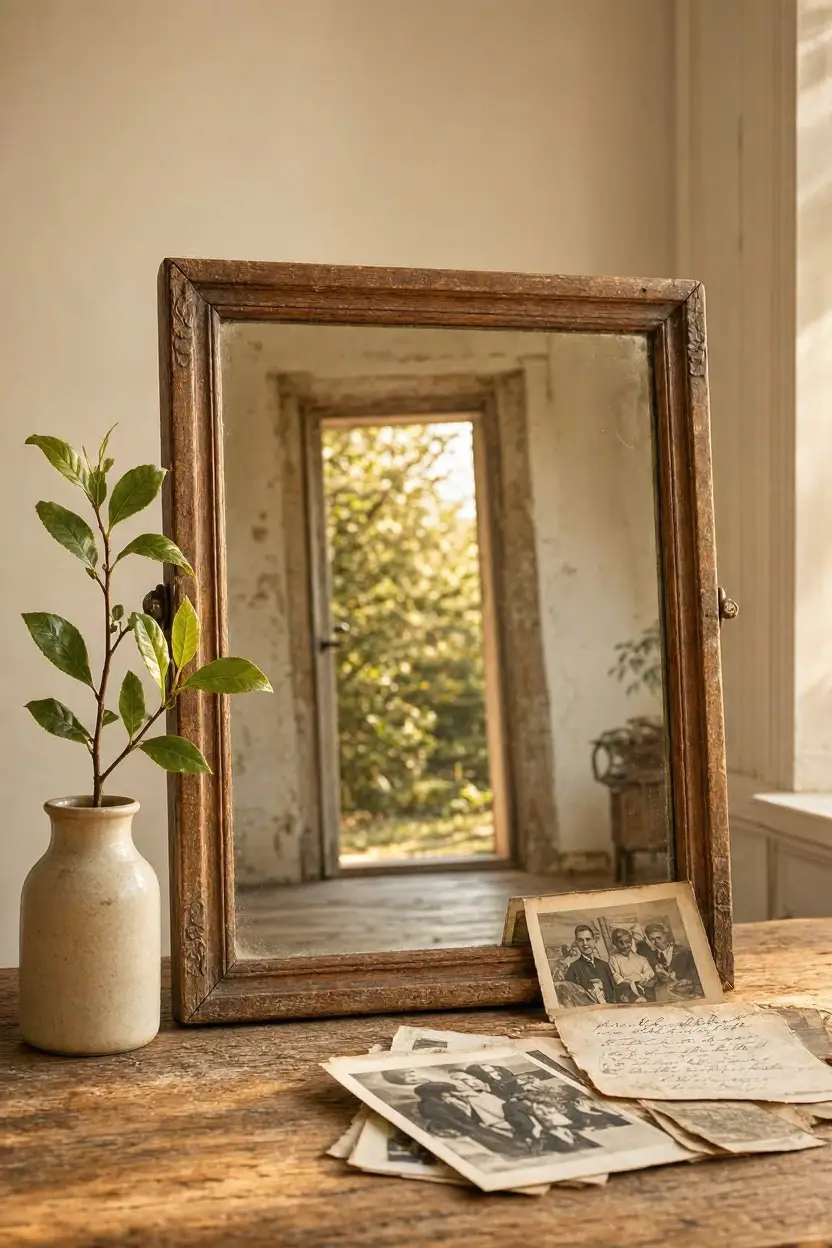
That is where the mirror becomes useful.
It isn’t there to give us someone to blame.
It’s there so we can see.
Awareness opens a door; it does not finish the work
I also want to be careful with the phrase Once we recognize a pattern, we have a choice.
I believe recognition matters. But I don’t mean that awareness makes change immediate or easy.
Noticing a pattern and knowing how to interrupt it are different things.
I don’t want “You can choose differently” to become another way of saying, “You should have fixed this by now.”
The responsibility I’m talking about is not a demand for instant perfection. It is a willingness to take the next honest step.
That might mean acknowledging an impact instead of defending an intention.
It might mean returning to a difficult conversation and saying, “Let me try that again.”
It might mean asking for help rather than insisting we ought to manage everything alone.
And sometimes it means accepting that understanding our family does not require us to tolerate harmful behavior within it.
Compassion and boundaries are not opposites.
We can recognize what someone endured without making ourselves available for more harm. We can understand a family pattern without agreeing to continue our assigned role in it.
We inherit more than wounds
There is something else I don’t want us to lose.
When we talk about generational inheritance, we can become so interested in trauma that we begin looking backward only for damage.
Every resemblance becomes a symptom. Every silence becomes a secret. Every difficult ancestor becomes an explanation for what is wrong.
But our family histories contain more than suffering.
Where did your love of music come from?
Who else could pick up an instrument and play by ear? Who had the beautiful singing voice? Who could fix nearly anything that broke?
Who painted? Who told wonderful stories? Who had an extraordinary head for numbers? Who could coax a garden out of an unpromising patch of ground?
And who possessed that stubborn determination that occasionally drives everyone around you crazy—but has also carried you through some of the hardest moments of your life?
Those are ancestral questions, too.
When I use the word inheritance here, I mean more than DNA. I mean what reaches us through teaching, example, opportunity, stories, traditions, and the things a family notices and encourages.
Sometimes we may never know precisely why a particular interest or ability appears.
But genealogically, I find the question irresistible:
Who else was like me?
Finding that person can change the way we see both them and ourselves.
An ancestor stops being only a name followed by two dates. We discover a letter, a handmade object, a newspaper clipping, or someone’s remembered story—and a person begins to emerge.
Oh. There you are.
You loved that, too.
The recognition does not have to prove a biological connection to be meaningful.
Sometimes it is enough to discover that something we cherish in ourselves also had a place in someone else’s life.
Keep the gift. Question the cost.
Sometimes the difficult patterns and the gifts are tangled together.
I can admire a relative’s determination and still question the belief that rest must always be earned.
I can value resourcefulness without wanting fear to govern every financial decision.
I can treasure loyalty without accepting silence about harm.
That is a more demanding kind of family history than sorting our ancestors into good people and bad people. It asks us to consider what we admire, what troubles us, and where those feelings overlap.
Perhaps the question is not simply:
Do I keep this or reject it?
Perhaps it is:
What part of this do I want to preserve—and what part do I want to change?
I want the generosity, but not the expectation that I must give until nothing is left.
I want the perseverance, but not the conviction that needing help means failure.
I want the closeness, but not the rule that belonging requires agreement.
We do not have to preserve every part of a pattern to honor what was valuable in it.
Nor do we have to dismiss everything an ancestor gave us because some of it caused pain.
Decide what stays
Perhaps this is one of the most useful things we can do with our family history.
Look at what reached us.
Not simply the names, photographs, documents, and DNA matches, but the stories, abilities, fears, traditions, expectations, and ways of moving through the world.
Then look at them honestly.
Some things deserve further investigation.
Some deserve care and attention.
Some deserve firm boundaries.
Some deserve to end with us.
And others deserve to be celebrated, strengthened, written into our family histories, and deliberately carried forward.
Teach someone the recipe.
Record the story of the relative whose kindness rarely made it into the official family narrative.
Preserve the music, the craftsmanship, the humor, the curiosity.
And where something has caused harm, resist the temptation to let “That’s how our family has always been” end the conversation.
That sentence may describe a history.
It does not have to prescribe a future.
We don’t study our past so that the dead can dictate what happens next. We study it to better understand what arrived in our hands.
Then comes our part.
Keep this.
Care for this.
Change this.
Let this end here.
Carry this one forward.
That is not avoiding responsibility.
That is taking ownership of the inheritance.
Behind the Mirror prompt
Think about two things in yourself: one that makes life more difficult, and one you are grateful to possess.
Then ask:
- Who else in my family seemed to share this trait, interest, or way of responding?
- What do I actually know about them, and what am I assuming?
- What stories, records, or conversations might help me learn more?
- What do I want to handle differently?
- What do I want to preserve or pass on?
You do not need to uncover a single origin story or reach a final verdict about an ancestor.
Start with curiosity. Leave room for uncertainty. Pay attention to the gifts as well as the difficulties.
The ancestral mirror may reflect something painful.
Sometimes, it reflects treasure.
0 Comments