
This week’s theme: The Gifts We Inherit
We genealogists are good at following names.
We chase them through census pages, marriage records, cemetery rows, and the occasional document that appears to have been written with a stick dipped in weak tea. We want to know who belonged to whom, where they lived, and what happened between the dates on the headstone.
But here is a different question to take into your next research session:
Who gave you that gift?
Your love of music. Your way with words. Your ability to coax something green out of an unpromising patch of dirt. The satisfaction you feel when you take apart a broken object and understand how to put it back together.
Not every family resemblance appears in a photograph.
Sometimes you recognize an ancestor in yourself not because of what hurt them, but because of what lit them up.
That is the invitation behind this week’s theme, “The Gifts We Inherit”: to look for the creativity, humor, curiosity, craftsmanship, and quieter abilities that belong in our family stories alongside the struggles. It also connects with an idea at the heart of The Ancestral Mirror: inheritance includes qualities we may want to recognize and carry forward, not only patterns we hope to change.
Let’s turn that idea into a practical genealogy project.
1. Start with yourself—and put modesty aside
Take out a notebook and write this question at the top:
What do I enjoy doing, and what do other people come to me for?
Notice that I did not ask what you have won awards for.
For this exercise, a gift does not need a certificate, a paycheck, or a place on a stage. Begin with abilities and interests, including the ones you tend to dismiss because they feel ordinary to you.
Perhaps you:
- Tell a story people want to hear.
- Repair things rather than replace them.
- Remember melodies after hearing them once.
- Make a meal without consulting a recipe.
- Organize complicated information.
- Draw, sew, carve, build, or grow things.
- Notice when someone needs to be included.
- Ask questions that send everyone else looking for answers.
Choose one interest to investigate first. “Creativity” is a large territory. “Making clothing,” “writing humorous letters,” or “playing music by ear” gives you a more manageable starting point.
Then describe what you actually do.
Instead of writing “good with plants,” try: “I propagate cuttings, save seeds, and keep notes on what grows well.”
Specific actions give you something to compare with the evidence you find. They also help you avoid turning every vaguely similar family story into a match.
You are beginning an investigation, not announcing a conclusion.
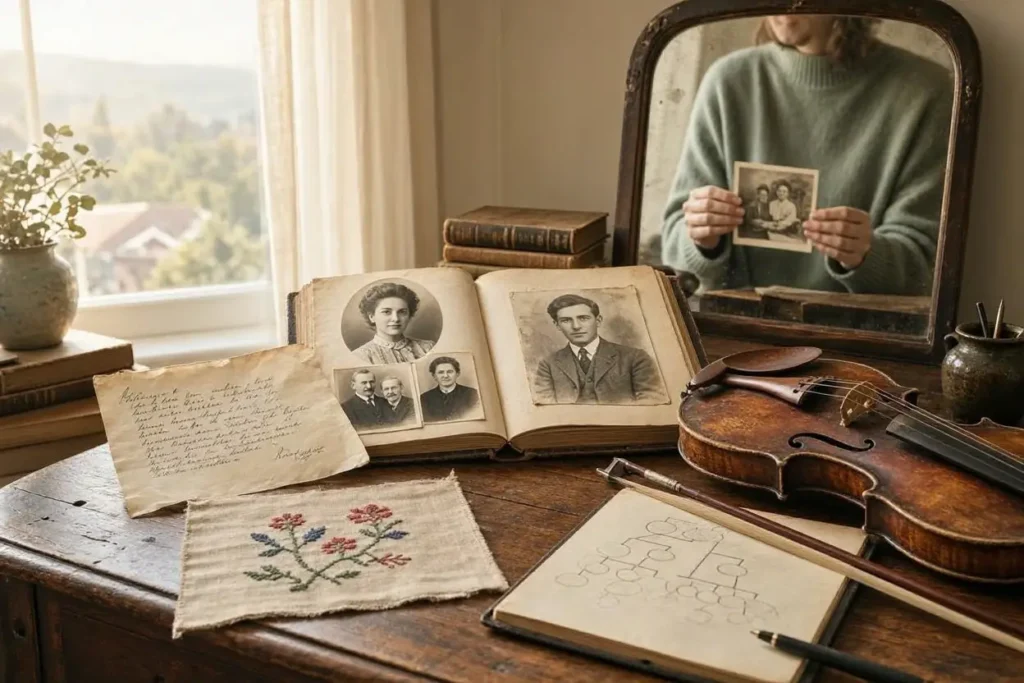
2. Look sideways before you march backward
The temptation is to head straight for the oldest generation you can name.
Resist it for a moment.
First, look across your family: siblings, cousins, aunts, uncles, and the relatives whose names sit off to the side of your usual research path. Looking sideways is a central part of the Talent Trail proposed in this week’s outline.
I learned how different siblings’ talents can be during one frustrating piano practice session. I was struggling with a piece, trying again and again to get it right. Finally, I slammed my hands down on the keys and left the room. Seconds later, I heard my baby brother playing the same piece beautifully. He had never had a lesson. What I was working so hard to master seemed to come naturally to him. It was not the most comforting discovery at the time, but it reminds me why looking sideways matters: even within the same family, a gift can show up differently in each of us.
Who shares your interest? Who expresses something similar in a different form?
Imagine that you write family histories, a cousin creates elaborate scrapbooks, and an aunt narrates every gathering with a well-timed story. You would not necessarily label all three activities “writing.” But you might investigate a shared interest in preserving and presenting experience.
Keep those descriptions separate at first:
- You write researched narratives.
- Your cousin arranges photographs and captions.
- Your aunt tells stories aloud.
Only then add the broader question: Is storytelling a recurring family interest?
That order matters. Start with what people do, then explore the connection.
Include adoptive relatives, stepparents, and other people who helped raise or teach you. You can distinguish biological relationships from teaching relationships without treating one as more meaningful than the other.
A talent trail can follow the person who demonstrated a skill, supplied the materials, or made you believe you were allowed to try.
3. Read the occupation—but do not let it finish the story
An occupation is a useful clue. It is not a complete portrait.
The family musician, for example, may have been listed simply as a farmer on every census. That tells you how they earned a living, but not what they loved to do.
So, after recording how an ancestor earned a living, ask a second question:
What did this person do when the paid work was finished—or alongside it?
For this project, try expanding your search beyond the records you usually consult:
- Family letters and diaries.
- Newspaper notices and community columns.
- Church, school, and club publications.
- Photographs with identifiable objects or activities.
- Recipe books, sewing patterns, sketchbooks, and handwritten music.
- Surviving furniture, tools, needlework, or other handmade objects.
Historical newspapers are one of the family-history resources highlighted by the Library of Congress, alongside maps and genealogy research guides. They offer another place to search when a conventional record leaves you with little more than a name and occupation.
When using a newspaper collection, experiment with a person’s name alongside words connected to your question: “choir,” “exhibition,” “garden,” “concert,” “prize,” or “society.”
Treat every result as something to examine, not something to claim immediately. Does the location fit? Is the date plausible? Can you connect that person to a known address, spouse, or organization?
And be precise about what the item establishes. A concert notice naming someone as a performer documents participation in that concert. It does not, by itself, tell you how accomplished the person was or how many years they played.
A small, accurate discovery is worth more than a splendid assumption.
4. Listen for the sentence hiding inside the family story
Some clues arrive without looking like clues.
“She could make anything.”
“He always had a story.”
“She knew every plant in the hills.”
Those are among the descriptions suggested in the outline, and each one gives us a promising place to begin asking questions.
The next step is to move from the general description to a remembered scene.
If someone says, “Your grandmother was wonderful with her hands,” ask:
- “What do you remember her making?”
- “Did you ever watch her work?”
- “Who taught her?”
- “Did she teach anyone else?”
- “Does anything she made still exist?”
If the answer is “He was musical,” try:
- “What did he play or sing?”
- “Where did people hear him?”
- “Did he use written music?”
- “Who played with him?”
- “Are there photographs, recordings, or programs?”
Open-ended questions give the storyteller room to supply details rather than merely agree with your suggestion. The National Underground Railroad Freedom Center’s oral-history guidance recommends questions that cannot be answered with a simple yes or no, including prompts about relatives’ personalities, work, stories, and surviving heirlooms.
Avoid beginning with, “Wasn’t Grandma the artistic one?”
Try, “What did Grandma like to make?”
One asks for confirmation. The other leaves room for a surprise.
For your research notes, record who supplied the memory, when you spoke, and whether the person witnessed the event or heard about it from someone else. Ask permission before recording a conversation or sharing someone’s words.
A useful entry might read:
Telephone conversation with Aunt Helen, November 10. Helen remembers watching her mother alter clothing for neighbors. She also recalls being told that her grandmother did similar work, but did not see that herself.
Now you have two leads with different foundations: a firsthand memory and a story passed along.
Keep both. Just do not quietly turn them into the same kind of evidence.
5. Build your Talent Trail
Here is where the project becomes something you can see.
Create a simple table in a notebook, spreadsheet, or research document. The outline suggests four starting columns: person, talent or interest, evidence, and relationship.
I would add one more: next question.
The following example is entirely hypothetical:
| Person | Talent or interest | Evidence | Relationship | Next question |
| Me | Writing family stories | Completed essays | Self | Who encouraged me to write? |
| Mother | Humorous storytelling | Recorded conversation; letters | Mother | Are there earlier letters? |
| Great-aunt | Writing poems | Two signed poems in a scrapbook | Maternal great-aunt | Were any published? |
| Great-grandfather | Possible interest in storytelling | Relative’s secondhand recollection | Maternal great-grandfather | Are letters or notebooks preserved? |
Notice the word possible in the final row.
Leave it there until you find a reason to change it.
You can also mark entries as “documented,” “remembered,” or “possible.” These are working labels for your project, not ratings of a person’s worth or a substitute for examining the source.
The purpose is to stop a tentative connection from hardening into family fact simply because it looks attractive in a table.
Keep exact source details in accompanying notes. “Old newspaper” will be frustrating six months from now. Record the publication, date, page, and enough information to locate the item again.
As the table grows, consider adding approximate dates and places. Then ask whether the people involved actually had opportunities to learn from one another.
Did the aunt who sewed live nearby? Did the child spend summers with the grandfather who gardened? Did two cousins develop similar interests without knowing one another?
Those questions help distinguish a resemblance from a possible route of transmission.
6. Look for patterns without making everyone fit
Once you have several entries, step back.
Do you see one activity repeated? Different activities that may share an underlying interest? A person who taught several others?
Now deliberately look for what complicates your first impression.
Perhaps the supposed “family of musicians” includes two enthusiastic players and several people who had no interest at all. Perhaps the woodworking trail leads to a neighbor rather than an ancestor. Perhaps the gifted cook learned through employment, not at home.
Keep those discoveries.
Do not make the pattern tidier than the evidence.
Also leave room for the difference between “not found” and “not present.” If you have found no evidence that a great-grandmother painted, write that—not that she lacked artistic interests.
Try asking what you would expect to survive if she had pursued the activity. A signed watercolor would be helpful. But would anyone have kept her practice sketches? Would her letters mention it? Have you asked the relative who inherited her belongings?
This is a useful moment to revisit overlooked people and objects rather than simply search harder for the ancestor you hoped would fit.
The aim is not to award a talent to every generation. It is to discover what you can support—and remain curious about what you cannot.
7. Keep inheritance larger than DNA
Now for the question hovering over the whole exercise:
Does this prove I inherited my talent?
Not biologically.
A family table can show recurring interests, documented activities, and possible teaching relationships. It cannot establish which genetic influences, if any, account for a particular person’s abilities.
Music provides a useful example of the complexity. The Jackson Laboratory explains that musical ability appearing in families can suggest genetic influences, but can also reflect early exposure to music; its discussion of absolute pitch describes both environmental and genetic contributions.
So resist the satisfying but unsupported leap from “My great-grandfather played the fiddle” to “That is where my musical ability came from.”
You have found a connection worth exploring. That is already something.
For this project, allow inheritance to include instruction, encouragement, access, habits, and example. Note which kind of connection your evidence supports.
Perhaps someone taught you directly. Perhaps a parent kept books within reach. Perhaps an ancestor’s work has become an inspiration only now, long after their death.
You do not have to make a claim about chromosomes to recognize a meaningful legacy.
8. Turn one discovery into a small family story
Do not wait until you have traced the gift through six generations.
Choose one finding and write a paragraph with three parts:
- What you found.
- What it suggests.
- What remains unknown.
For example:
Two poems signed by my great-aunt survive in a family scrapbook. Until I found them, I had known her mainly through photographs and household records. Her poems add a new dimension to her story and give me another family connection to writing. I do not yet know whether she published her work or wrote regularly.
That paragraph lets the discovery matter without asking it to prove too much.
Preserve it with a copy of the evidence and your source notes. If you share it with relatives, explain what you are still trying to learn. Someone may recognize the handwriting, remember another poem, or know where a missing notebook went.
Then carry one part of the gift forward: try the recipe, learn the tune, photograph the carving, or write down the story.
A different way to look into the mirror
This week, choose one interest, one relative, and one question.
Make a five-row Talent Trail. Send one thoughtful message. Reopen one box.
You may find a documented connection. You may discover a teacher you had overlooked. You may learn that the activity you thought defined one branch of the family appeared somewhere entirely unexpected.
Or you may finish with a question mark.
That is an honest place to pause.
As we move toward next week’s theme, “The Things Our Families Leave Behind,” consider the objects that might hold your next clue: a marked-up cookbook, a worn tool, a letter, a song written in the margin of a notebook.
Our ancestors left more than problems for us to untangle. This project makes room to look for what they enjoyed, practiced, made, and shared.
You already trace their names.
Now try tracing what lit them up.
0 Comments