
I have been collecting family stories for as long as I can remember. Before I knew the word genealogy, I knew there were names that mattered, places that carried weight, and certain stories that were repeated with such confidence they seemed carved in stone. Some came from elders around a kitchen table. Some arrived in letters, newspaper clippings, photo albums, and handwritten notes. Others were passed along in that familiar family shorthand: “everybody knows,” “Grandma always said,” or “that’s just how it happened.”
For a child with a curious mind, these stories were treasures. I tucked them away carefully. I listened for repeated names. I studied faces in old photographs. I noticed when one version of a story did not quite match another. Over time, those fragments became more than family lore; they became part of the emotional architecture of my family history.
But years of research have taught me something every genealogist eventually learns: a family story can be meaningful without being entirely true. It can contain a memory, a wound, a wish, a misunderstanding, a protective silence, or a practical explanation that made sense to someone at the time. It may have been repeated not because it was accurate, but because it was useful. It helped a family make sense of loss, migration, poverty, estrangement, scandal, pride, or survival.
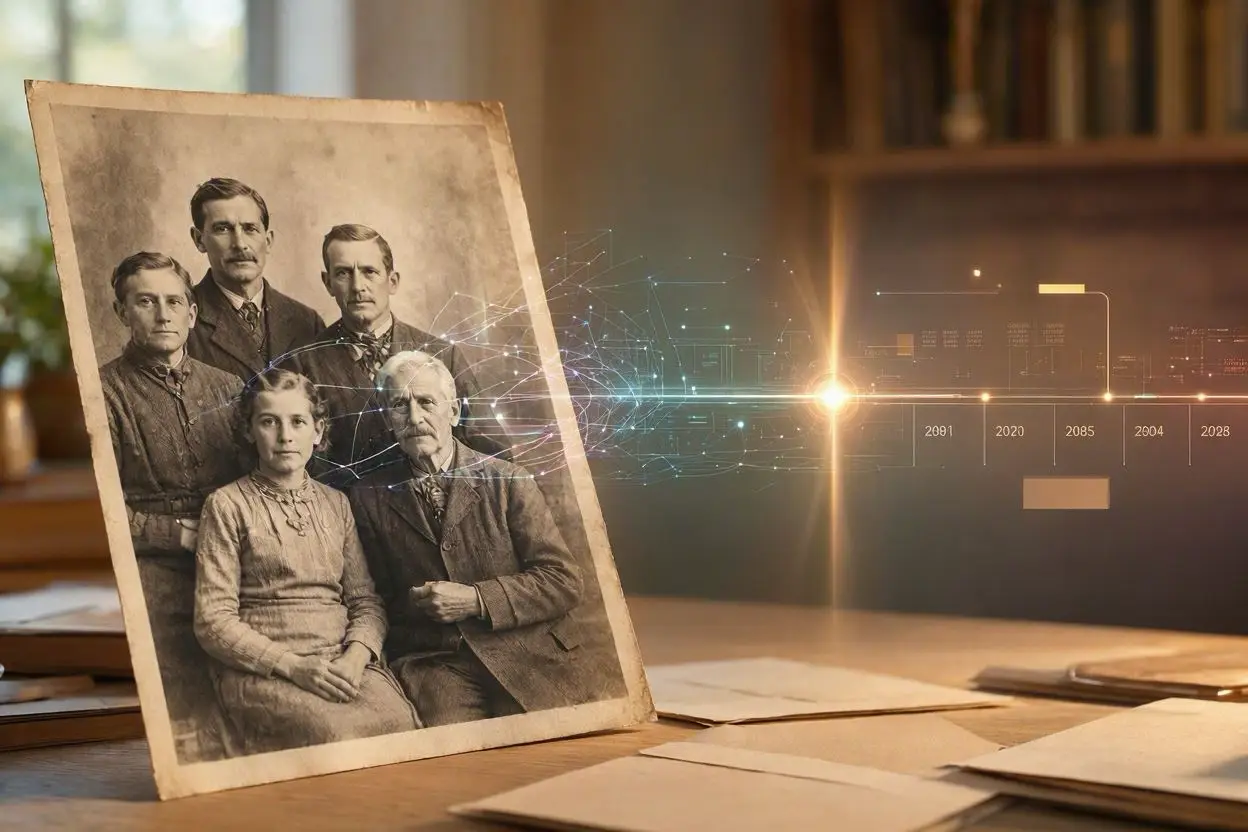
Genealogists encounter this all the time: stories that appear deeply personal but turn out to be part of a larger cultural myth. During World War II, for example, many families repeated nearly identical tales—like the grandfather declared dead until a single tear revealed he was still alive—because such narratives traveled through communities as shared folklore. They offered meaning, caution, or comfort, and over time people wove them into their own lineage as though they were inherited memories. AI helps us recognize these patterns by comparing accounts across regions, eras, and archives, revealing when a story is collective rather than individual and helping us understand the truth it was trying to carry.
That is why I find myself thinking more and more about the role of artificial intelligence in genealogy—not as a replacement for research, and certainly not as an oracle, but as a new kind of mirror. AI can help us look again at stories we thought we already understood. When used carefully, it can become a neutral lens, one that does not know Aunt So-and-so’s opinion, does not care which branch of the family “won” the argument, and does not need to preserve the version that has been repeated for generations.
The stories we inherit are not always the whole story
Family narratives often begin as explanations. Why did someone leave home? Why did a name change? Why was a relative never mentioned? Why did one sibling disappear from the record while another became the keeper of the family Bible? In the absence of documents, families fill the silence with stories. Sometimes those stories are loving. Sometimes they are defensive. Sometimes they are meant to protect children from painful truths. Sometimes they are shaped by class, religion, gender expectations, immigration pressures, or the need to appear respectable in a particular time and place.
As a genealogist, I do not want to sneer at these stories or treat them as foolish. They were often carried by people doing the best they could with what they had. An old story may preserve the emotional truth of an experience even when the dates, names, or motives are wrong. The phrase “he ran away” may hide an economic migration. “She was orphaned” may mean she was living with relatives while her parents worked elsewhere. “They came from the old country with nothing” may be both a proud memory of hardship and an incomplete account of networks, sponsors, property, or skills that helped them survive.
The danger is not that families tell stories. The danger is that we stop questioning them. Once a story becomes part of family identity, it can be very hard to loosen our grip. We may unconsciously search for evidence that confirms it and ignore evidence that complicates it. We may preserve a flattering version because it feels kinder, or a tragic version because it gives shape to suffering. We may even inherit someone else’s prejudice and mistake it for fact.
Where AI can help us look again
AI is useful in genealogy because it is very good at patterns. It can compare timelines, summarize conflicting notes, transcribe difficult handwriting, translate documents, suggest research gaps, and help organize years of scattered material into something we can see more clearly. Several current genealogy discussions emphasize the same caution: AI can speed up work, but it cannot replace judgment, source verification, privacy awareness, or ethical disclosure. It is best treated as an assistant, not an authority. Responsible genealogy still depends on accuracy, transparency, and care.
But that assistant role can be surprisingly powerful when we are trying to re-examine an inherited narrative. I can feed AI a timeline and ask, “What assumptions am I making here?” I can ask it to separate known facts from family claims. I can ask it to list alternative explanations for a person’s movement, a missing record, a sudden remarriage, a name variation, or a long-standing rupture between relatives. I can ask it to identify what evidence would strengthen or weaken each possibility.
The value is not that AI tells me the truth. It does not. AI can be wrong, and it can sound confident while being wrong. The value is that it can interrupt my own mental rut. It can help me see where I have treated a conclusion as settled simply because I have heard it all my life.
In that sense, AI becomes less like a fortune teller and more like a patient research partner who says, “Let’s slow down. What do we actually know? What are we guessing? What are we afraid to disturb?”
The difference between evidence and inheritance
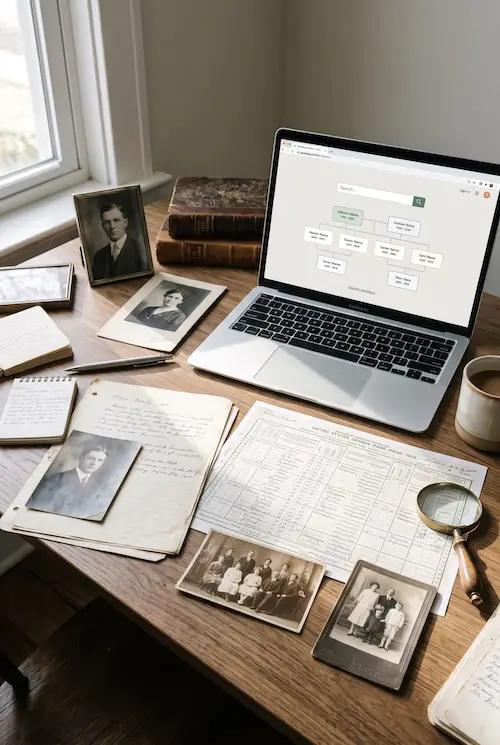
One of the most helpful exercises I use is to divide a family story into three columns: what was said, what is documented, and what remains possible. This sounds simple, but emotionally it can be difficult. A beloved story may shrink under the weight of records. A dismissed relative may suddenly appear more complicated, more human, or more unjustly treated. A supposed black sheep may turn out to have been poor, widowed, ill, abandoned, or simply living outside the expectations of the family storyteller.
AI can help with that sorting. If I paste in a short family narrative and a set of records, I can ask it to mark each sentence as documented, plausible, unsupported, or contradicted. Then I can review its response against the actual sources. I may disagree with the AI, and often I should. But the process forces me to name the difference between evidence and inheritance.
That distinction matters because genealogy is not only about collecting ancestors; it is about accountability to them. We owe them curiosity. We owe them humility. We owe them the possibility that their lives were not as simple as the family version made them sound.
Old myths often protect old wounds
Of course, letting go of an old story is not always comfortable. Family myths can be emotional heirlooms. They may protect a grandmother’s pride, a parent’s pain, or a child’s understanding of where they came from. When we challenge those stories, we are not simply correcting trivia. We may be touching grief, shame, loyalty, or belonging.
This is where AI’s neutrality can be useful, but also where human discernment is essential. AI does not understand family tenderness. It does not know which words will reopen a wound at Thanksgiving dinner. It cannot decide whether a discovery should be shared widely, held privately, or framed gently. That responsibility belongs to us.
Still, a neutral lens can help us avoid another danger: letting emotion decide the facts. We can ask AI to propose nonjudgmental language. We can ask it to rewrite a harsh family label in a more historically sensitive way. We can ask it to help us tell a story with both honesty and compassion. Instead of “he abandoned the family,” we might write, “the records show he was living separately by 1910, but they do not explain why.” Instead of “she lied about her age,” we might say, “her reported age varies across records, a common occurrence in historical documents.”
That shift in language is not cosmetic. It changes the moral posture of the researcher. It reminds us that our ancestors were people, not plot devices.
Using AI without surrendering judgment
For me, the safest way to use AI in family history is to keep it in its proper place. I use it to ask better questions, not to declare final answers. I use it to organize, compare, brainstorm, and draft. I do not use it as a source. If it suggests a fact, I verify that fact. If it summarizes a document, I read the document. If it offers a theory, I treat that theory as a research lead, not a conclusion.
I also think carefully about privacy. Family history is full of living people, sensitive memories, DNA results, adoption stories, medical hints, and personal documents. Before uploading material into any AI tool, we should understand what happens to that data and whether we have the right to share it. Ethical AI use in genealogy includes protecting private information, disclosing when AI materially shaped our work, and verifying conclusions against reliable sources. These principles are not obstacles to creativity; they are what keep our work trustworthy.
A simple workflow might look like this: write down the family story exactly as you heard it; gather the records you already have; ask AI to separate claims from evidence; review every result yourself; list alternate explanations; identify missing records; and then rewrite the narrative with careful language. The finished story may be less dramatic than the inherited version, but it will often be richer, kinder, and closer to the truth.
Letting go is not erasing
When I say we may need to let go of old stories, I do not mean we should erase them. Old stories are evidence too—not always evidence of what happened, but evidence of what a family believed, feared, valued, or needed to remember. I want to preserve the inherited version and the revised version side by side. One tells me about the ancestor. The other tells me about the descendants.
That is the beauty of the mirror metaphor for me. A mirror does not create the face it reflects, but it may show us something we missed: a resemblance, a shadow, a crack in the frame, a detail hidden by habit. AI, used thoughtfully, can do something similar for family history. It can help us hold a story up to the light and ask not only, “Is this true?” but “What else might be true?”
After a lifetime of listening to family stories, I still believe in them. I believe in their power to connect generations, to keep names alive, to turn dates and documents into human lives. But I no longer believe every inherited story should remain untouched. Some deserve to be honored. Some deserve to be questioned. Some deserve to be gently retired.
AI gives us one more way to do that work. Not coldly. Not recklessly. Not by replacing the genealogist’s heart with a machine. But by giving us a little distance from the assumptions we inherited, a little structure for the evidence we gathered, and a little courage to ask whether the story we were handed is the story we should pass on.

0 Comments