
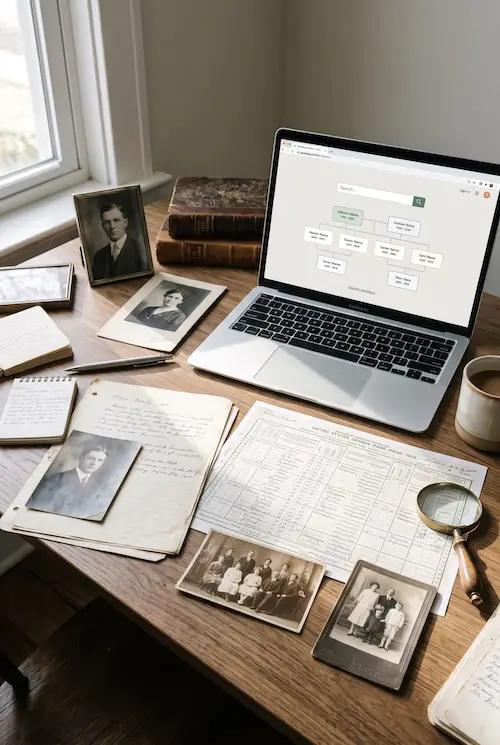
Using AI to Simplify Your Genealogy Workflow
If you’re like me, you may feel a particular kind of overwhelm that comes with family history work.
It is the feeling of having too many browser tabs open, too many downloaded records with names like “IMG_4829,” and too many questions pulling you in different directions at once. A census record leads to a marriage certificate. A marriage certificate raises questions about a maiden name. A photograph surfaces with three unfamiliar faces and no date.
Before long, research stops feeling like discovery and starts feeling like noise.
As a professional genealogist, I have learned that the answer is rarely to work harder. More often, the work asks us to pause, sort what we already have, and make space for the next right question.
That is where AI can be genuinely helpful—not as a substitute for evidence, judgment, or the human heart behind the story, but as a calm assistant at the edge of the desk.
The goal is not to let AI “do your genealogy.” The goal is to let it reduce the friction that keeps you from doing it well.
Begin With the Pile
Most genealogy overwhelm is not caused by a lack of information. It is caused by information without a container.
You may have family group sheets, DNA matches, cemetery photographs, handwritten notes from a relative, screenshots from online trees, and folders full of documents waiting to be reviewed. Each item may matter. But when everything feels equally urgent, it becomes difficult to see what truly needs your attention.
AI can help you create order before you begin chasing another hint.
Try gathering a small sample of your material—perhaps five document summaries, a research log, or a list of open questions—and ask AI to help you sort it into simple categories:
- Facts supported by records
- Clues that need verification
- Conflicting information
- Missing records
- Questions to pursue next
That one exercise can change the emotional temperature of your research. Instead of facing a wall of unfinished work, you begin to see a map.
Let AI Organize, Not Decide
AI is especially useful for tasks that are repetitive, administrative, or difficult to begin.
For example, you can paste rough research notes into an AI tool and ask it to turn them into a clean research log. You can provide a folder list and ask for a sensible naming convention. You can dictate a stream-of-consciousness note after a research session and ask AI to identify the names, places, dates, sources, and follow-up tasks buried inside it.
A prompt might look like this:
“Act as a genealogy research assistant. Organize the notes below into a table with columns for person, event, date, place, source, evidence status, and next research step. Do not invent missing facts. Flag uncertainties clearly.”
That last sentence matters.
AI can organize what you give it, but it can also sound confident when it is wrong. In genealogy, confidence is not proof. A polished answer is not the same thing as a documented conclusion.
The genealogist’s role remains essential: evaluate the source, compare the evidence, understand the historical context, and decide whether a conclusion is actually supported.
Turn Questions Into a Plan
When research feels scattered, it is often because the question is too large.
“Who were my great-grandmother’s parents?” may sound like one question, but it contains many smaller ones. Where was she born? What surname did she use before marriage? Does a death record name her parents? Did she appear in a household before she married? Are there siblings whose records may offer clearer evidence?
AI can help break a broad question into manageable research steps.
You might ask:
“I am trying to identify the parents of Anna Maria Lopez, born about 1887 in New Mexico and married to Samuel Reyes by 1908. Create a prioritized genealogy research plan using original records where possible. Include the purpose of each record type, what details to look for, and possible spelling variations. Do not state conclusions.”
This is where AI becomes less like an answer machine and more like a planning partner. It helps turn a foggy research problem into a sequence of practical next steps.
And sometimes, that is all we need to begin again.
Use AI to Read the Edges
Family history rarely lives only in the obvious facts.
It lives in the witnesses on a marriage record. The neighbor who appears beside a family across three census years. The name of a person who paid for a burial. The occupation repeated across generations. The move that happened between one child’s birth and the next.
AI can help you notice patterns across material that may be too large or too scattered to hold in your mind all at once.
For example, you can provide a transcription of several census households and ask AI to identify repeated surnames, nearby families, occupations, migration patterns, or changes in household composition. You can use it to build a timeline from already verified events, making gaps and contradictions easier to see.
But the language matters. Ask AI to identify possible patterns, not to declare relationships.
A helpful prompt is:
“Review this timeline and identify patterns, inconsistencies, and questions that may deserve further research. Separate documented facts from inferences. Do not assume that people with the same surname are related.”
That distinction protects your tree—and respects the people within it.
Make Space for the Story
A research workflow is not only about finding records. It is also about staying connected to why the records matter.
Sometimes we become so focused on collecting names and dates that we lose sight of the human lives beneath them. A woman appears in a census as “widowed.” A child disappears between enumerations. A family crosses the country in the middle of economic hardship, war, illness, or loss.
The record may be brief. The story it suggests is not.
AI can help us translate research notes into readable narrative drafts, interview questions for relatives, or reflective journal entries about what we are learning. It can help us prepare a family-history summary that is clear without becoming clinical.
Still, the technology cannot tell us what a silence meant.
It cannot know whether a missing name reflects grief, estrangement, migration, an indexing error, or a record that has simply not survived. Those spaces require patience. They require context. They require the humility to say, “I do not know yet.”
That is not a failure in research. It is an honest place to stand.
A Simple Weekly Workflow
If your genealogy feels unmanageable, try this gentle rhythm:
- Choose one research question. Keep it specific enough to investigate in a single session or week.
- Gather what you already have. Pull together prior notes, records, citations, screenshots, and unresolved clues.
- Ask AI to organize the material. Request a timeline, research log, conflict list, or prioritized task list.
- Research with original records. Use AI’s suggestions as leads, then verify each claim with reliable sources.
- Record your findings. Add citations, explain your reasoning, and note what remains uncertain.
- End with the next question. Before closing your session, write down one clear, achievable next step.
This approach does not make genealogy less meaningful. It makes room for meaning by reducing the clutter around it.
The Tool Is Not the Guide
AI can save time. It can help us name patterns, organize a backlog, draft a plan, and turn tangled notes into something we can work with. Used thoughtfully, it can give overwhelmed researchers a little more clarity and a little more momentum.
But AI does not replace the work of listening.
It does not replace the slow comparison of records, the careful reading of a document, or the moment when a family story begins to shift because new evidence has come to light. It cannot sit with a photograph and feel the pull of recognition. It cannot decide what a discovery means to you.
That part remains human.
Perhaps that is the best way to welcome AI into genealogy: not as an oracle, and not as a shortcut, but as a practical companion. A second set of hands helping you clear the desk so you can see the archive—and yourself—more clearly.


0 Comments