
Why unfinished family stories remain with us, and how story mapping can help us investigate them
Some family stories arrive with a beginning, a middle, and an ending.
Others arrive with a lowered voice.
“She never talked about her father.”
“He left one morning, and nobody heard from him again.”
“We were always told not to ask about that side of the family.”
Then there are the stories told with a laugh: the ancestor who supposedly escaped through a window, the great-grandmother who could see things before they happened, the old house where someone still heard footsteps after its last occupant died.
October seems an especially good time to pull up a chair for these stories. But not everything that haunts a family tree is a ghost.
Sometimes it is a question that nobody answered. Sometimes it is a person whose name disappeared from conversation. Sometimes it is an explanation repeated so often that no one remembers it was ever an explanation rather than an established fact.
After 35 years as a hobby genealogist, I still find these stories among the most compelling—and the easiest to mishandle. A good mystery can send us searching. A story we desperately want to prove can send us searching in only one direction.
The challenge is to remain curious without becoming attached to a particular ending.
That is where story mapping can help: giving the inherited account, the available evidence, and our unanswered questions separate places on the page.
1. The Stories We Inherit Without Proof
We rarely receive family history in tidy, labeled folders.
We receive a remark while someone washes dishes. A warning about trusting relatives. A photograph turned facedown. A joke that makes everyone laugh except one person.
“He married beneath himself.”
“She was sent away for her health.”
“They lost everything.”
Each sentence contains the outline of a story. None tells us enough to know precisely what happened.
What does “lost everything” mean? A failed business? A foreclosure? An inheritance that never materialized? A move from ownership to rented rooms?
And who decided the marriage was beneath him?
Before we research the event, it helps to notice the language.
Words such as “disappeared,” “abandoned,” “respectable,” and “disgraced” do more than describe. They offer a judgment. If we copy them into our research notes without attribution, we risk turning someone’s interpretation into our own conclusion.
Instead of writing:
Arthur abandoned his family in 1924.
Try:
According to his granddaughter Ellen, Arthur “went away and never came back.” Ellen recalled hearing this from her mother. The date and circumstances remain unverified.
That second version is less dramatic. It is also more useful. It preserves the account while making clear whose account it is.
There is another distinction worth making at the outset.
An incomplete story has a gap: we do not know where an ancestor lived between two censuses.
A haunting story has a gap that continues to matter: the missing years have become the reason the family calls him untrustworthy, or the reason one branch refuses contact with another.
Not every missing fact shapes a family. But when a story becomes an explanation for who “we” are, it deserves attention beyond filling in a date.
2. Why Certain Stories Keep Returning
When I sit with a persistent family story, I like to ask two different questions:
What happened?
What has this story come to mean?
Those questions belong beside each other, but they are not interchangeable.
Imagine a family that repeats, “Your great-grandmother never accepted help from anyone.”
Research might eventually reveal that she lived with a sister, received assistance from a church, or borrowed money from a relative.
That would challenge the literal account. It would not necessarily tell us why her descendants remembered her as fiercely independent.
Perhaps she disliked needing help. Perhaps her children admired her determination. Perhaps a complicated period of dependence became, in the retelling, a simpler story about strength.
Those are possibilities to investigate—not explanations we can assign from a distance.
“A family story does not have to be completely accurate to reveal something true.”
The important question is: true about what?
A story may be unreliable as a description of an event while revealing something about how a teller understood that event. It may show admiration, resentment, loyalty, embarrassment, or a wish to protect someone.
But “emotional truth” is not permission to declare an imagined motive.
We cannot conclude that an ancestor felt ashamed simply because later generations avoided discussing her. We can say that a particular relative remembered the subject as uncomfortable, or that the versions we have collected consistently leave her unnamed.
That is a smaller claim, but a stronger one.
For this exercise, keep two questions visible:
- What can I establish about the past?
- What can I establish about how the past was remembered?
The answers may overlap. They may also lead in different directions.
3. What Is Missing From the Story?
Before opening another database, take a closer look at the account you already have.
I suggest starting with five questions.
Who first told it?
Write down the earliest teller you can identify—not necessarily the earliest person who ever told it.
Did your aunt witness the event? Did she hear it from her mother? Or does the trail end at “everybody knew”?
Try sketching the transmission:
Grandfather → his daughter → my cousin → me.
That chain gives you a research task. You can ask each available person what they actually heard, rather than assuming everyone received the same version.
Five relatives repeating one grandmother’s account are five tellers. They are not automatically five independent witnesses.
Who is absent?
Does the story describe a marriage without giving the wife a voice? Does it explain a departure without mentioning the children? Does “the family decided” conceal the fact that one person made the decision?
List everyone affected, including people who appear only briefly.
Then ask whose account you have—and whose you do not.
Whose version became accepted?
A useful interview question is:
“Did anyone in the family tell that differently?”
It makes room for disagreement without announcing that the familiar version is wrong.
You might follow with:
“What did you think about it when you first heard it?”
That separates the inherited account from the listener’s response.
Which details change?
Collect versions separately before trying to combine them.
One cousin remembers a departure after a funeral. Another places it before a wedding. One says there was a letter; another says there was never any contact.
Do not smooth those differences into one polished narrative. The differences are part of what you need to investigate.
What question have we never asked?
Sometimes our wording assumes the answer.
“Why did he abandon them?” assumes abandonment.
“What do we know about when he stopped living with them?” leaves room for discovery.
The Smithsonian’s oral-history guidance recommends open-ended questions, attentive listening, and a non-threatening approach to questionable information. That is a useful model for family conversations, too: invite the account before trying to correct it.
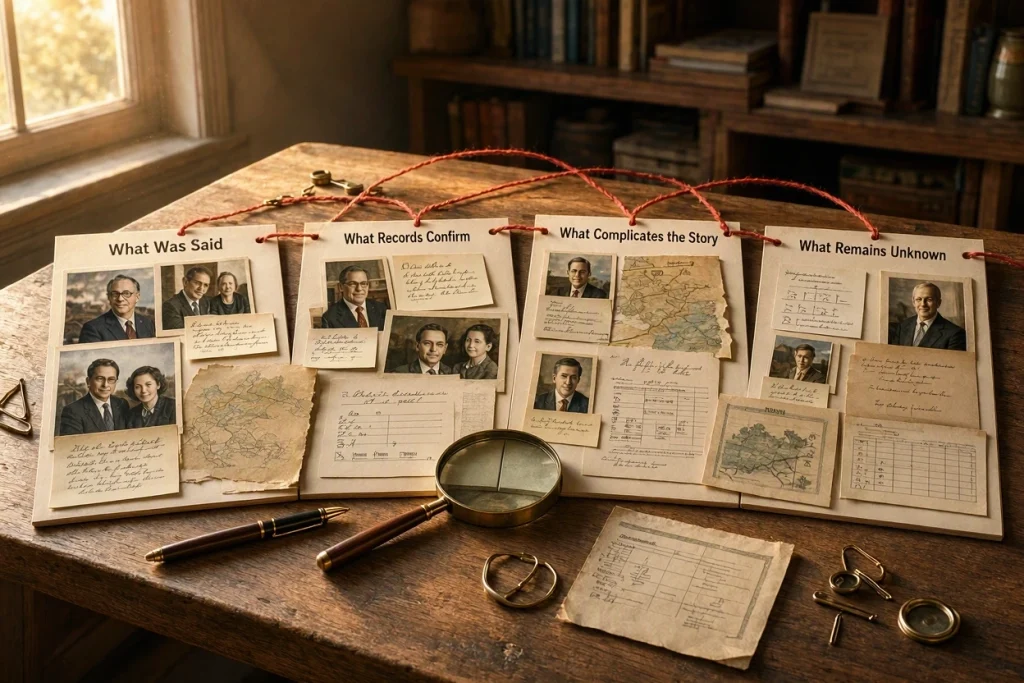
4. Create a Story Map
A story map does not need special software. A notebook page, spreadsheet, or document will do.
For this exercise, create four sections:
- What was said.
- What records confirm.
- What contradicts or complicates the story.
- What remains unknown.
Add a small space underneath for your next research question.
The point is not to make the mystery look organized. It is to prevent the story, the evidence, and your interpretation from quietly merging.
Step One: Preserve the Story Before Revising It
Write down the account as you received it.
Include:
- The teller’s name and relationship to the people involved.
- When and how you received the account.
- Whether the teller witnessed anything firsthand.
- Exact wording where you have it.
- Any uncertainty about your own recollection.
If you remember only the gist, say so. Do not put quotation marks around a sentence reconstructed from memory.
You might write:
My summary of a conversation with Aunt Jean, approximately 2008. I remember her saying that Thomas left after an argument. I do not remember whether she named the person involved.
That is useful information. It is also honest about its limits.
Step Two: Break the Story Into Testable Claims
“The family lost the farm, and Thomas disappeared because he was ashamed” sounds like one story.
It actually contains several claims:
- The family occupied or owned a farm.
- They lost ownership or possession of it.
- Thomas left.
- His departure followed the loss.
- Shame motivated his departure.
Those claims require different kinds of evidence. Establishing a property transfer would not, by itself, establish Thomas’s reason for leaving.
Separate the claims before searching. Otherwise, one supporting detail can make the entire story feel proven.
Step Three: Map a Small Example
Here is an entirely fictional example to show how the process works.
The inherited story is:
“Thomas deserted the family after losing the farm. Nobody heard from him again.”
Your map might look like this:
| Part of the map | What you enter |
| What was said | A granddaughter recalled hearing from her mother that Thomas left after the family lost its farm. |
| What records confirm | A deed documents a property transfer. Later records place his wife and children in another household. |
| What complicates the story | A letter addressed to his wife appears to be from Thomas several years after his departure. Its authorship still needs checking. |
| What remains unknown | Whether the transfer represented financial distress; when Thomas left; whether he sent support; how much contact continued. |
| Next research question | Can the letter’s sender, date, and address be connected reliably to this Thomas? |
Notice what the map does not say.
It does not declare Thomas innocent. It does not decide that the family invented the story. It does not assume a letter meant reconciliation.
It shows where the inherited account and the emerging evidence need closer examination.
“Nobody heard from him again” may turn out to be inaccurate. It might also have meant “the children had no meaningful relationship with him.” Those are different claims. We need more information before choosing between them.
Step Four: Give Every Entry a Source
Beside each item, record enough information to find it again.
For an interview, include the speaker, interviewer, date, and recording or transcript location.
For a document, include the collection, identifying details, page or image number, and where you accessed it.
Also distinguish the document’s words from your conclusion.
The directory lists Thomas at this address is an observation.
Thomas moved there to avoid his family is an interpretation.
Give those statements separate lines.
Step Five: Put Events in Order
Below the map, make a short timeline.
Include dated events from records and separately labeled dates supplied by recollection. If a date is approximate, keep it approximate.
Then examine the sequence.
Does the supposed cause occur before the departure? Was the family already living apart before the property changed hands? Are two events being linked merely because they happened near each other?
A timeline will not explain motive. It can show when a proposed explanation needs reconsideration.
Step Six: Choose One Manageable Next Action
Do not end with “research Thomas.”
End with something you can actually do:
- Locate the complete deed and read the surrounding transaction details.
- Ask the letter’s owner about the envelope and its history.
- Search directories for a defined place and period.
- Interview the relative who remembers a different version.
- Identify which court held the relevant proceedings and whether records survive.
Also record searches that produce no result, including their scope.
“I did not find him in the records I searched” keeps the limits visible. “He vanished” turns those limits into a story.
5. The Story May Be Pointing Toward Something Else
Sometimes the original legend is not the best research question.
“The family changed its name overnight” might lead you to investigate spelling variations, deliberate name changes, or whether two people have been confused.
“She went to live with cousins” might lead toward migration, employment, schooling, caregiving, estrangement, or an informal family arrangement.
“He never spoke about his childhood” might leave you with several possibilities—and no reliable way to choose among them.
The temptation is to replace a familiar mystery with a more compelling one.
Perhaps the silence conceals adoption. Perhaps the departure reflects financial hardship. Perhaps an identity changed. Those are possible lines of inquiry, not discoveries.
For each explanation you consider, ask:
- What evidence would support it?
- What evidence would make it less likely?
- What other explanation fits what I currently know?
- Am I favoring this possibility because it explains the evidence—or because it makes a satisfying story?
Include ordinary possibilities. A household may have separated for work. A relative may have lost an address. Two people with similar names may have become one person in the retelling.
And sometimes something painful did happen.
That is when curiosity needs boundaries.
Before recording a relative, explain your purpose and ask permission. Be clear about whether the conversation is for private research, family circulation, or publication. Oral History Association guidance emphasizes informed consent and clear expectations about an interview’s use and public release.
A person may also decline a question, take a break, or end an interview. Respecting that choice is part of responsible inquiry, not an obstacle to it.[See Oral History Best Practices]
A useful opening is:
“I’m trying to understand how this story was passed down, not prove anyone wrong. Is it something you’re comfortable discussing?”
And if the answer is no, stop.
An unanswered question does not give us ownership of someone else’s experience.
6. We May Not Solve the Mystery—But We Can Change the Question
There is a particular satisfaction in finding the record that makes everything click.
A letter survives. A name becomes recognizable. A date moves, and a confusing sequence finally makes sense.
But not every haunting story will give us that ending.
We may never know why someone left. We may establish that contact continued without understanding its quality. We may identify the earliest teller without discovering where that person learned the story.
The map still has value.
It allows us to write:
This is the account our family preserved.
This is what the records currently support.
This detail conflicts with another source.
This is what we cannot yet explain.
That is not an unfinished version of good genealogy. It is a careful account of where the research stands.
The reflective side of this work—the territory I return to in The Ancestral Mirror—asks us to notice what we carry alongside the names and dates. The research side asks us not to confuse that reflection with proof.
We need both kinds of attention.
This week, choose one story that keeps returning. Not the biggest secret. Not the most painful subject. Just one account you have always meant to examine.
Write it down. Name its source. Separate its claims. Make your four-part map.
Then choose one question you can responsibly investigate.
Perhaps the story will become clearer. Perhaps it will become more complicated. Perhaps you will discover that the event and the family’s explanation of it have been traveling together for so long that no one remembered they were separate.
We may never solve every mystery in the family tree.
But we can become more precise about what happened, more honest about what remains unknown, and more thoughtful about why a particular story survived.
Sometimes that is how we begin to understand what has been haunting us.
Suggested Further Reading
If you would like to learn more about Oral History, check out these resources:
DoHistory’s Step-By-Step Guide to Oral History.
Utah Historical Society, Oral History Toolkit.
Oral History Association Principles and Best Practices
Oral History Society Getting Started
Boston Public Library Informed Consent (as well as many other articles on Oral History)
0 Comments