
Most people think they need a fully documented family tree before they can start understanding their lineage. They imagine they need names, dates, immigration records, old photos, or a grandparent who remembers everything. But the truth is simpler — and far more human.
You can begin mapping your family story with almost nothing.
Because story mapping isn’t about having all the information. It’s about learning how to work with the pieces you do have — even if they’re small, scattered, or emotionally complicated.
Today’s post is your gentle starting point.
Why Story Mapping Matters
Every family carries patterns — emotional, relational, behavioral, and sometimes spiritual. These patterns shape how we love, how we fear, how we protect ourselves, and how we move through the world.
Story mapping helps you see those patterns clearly.
It’s not genealogy in the traditional sense. It’s not about collecting facts for the sake of accuracy. It’s about understanding how the stories you inherited — told, untold, or half‑remembered — influence your identity.
When you map your story, you’re not just documenting your lineage. You’re decoding it.
Start With Just Three Pieces of Information
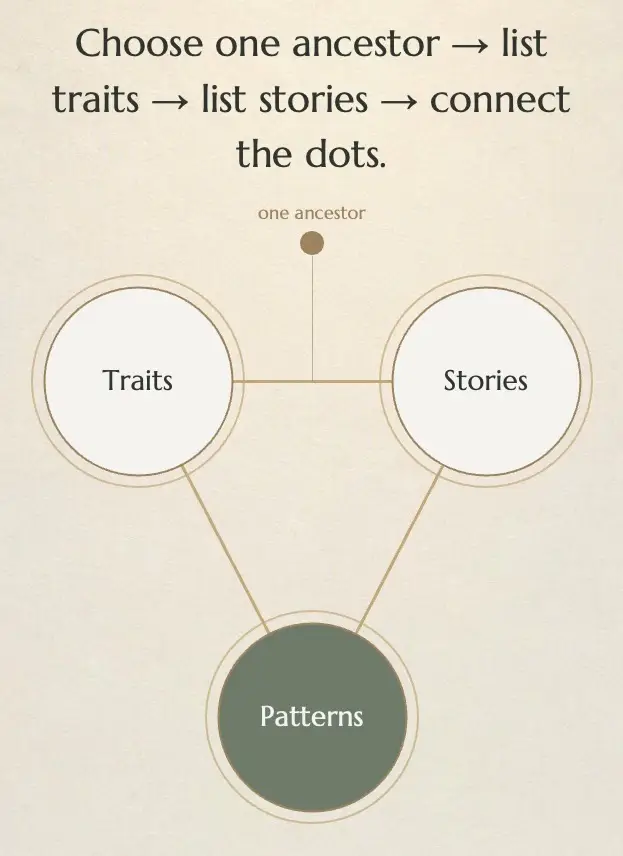
If you don’t know much about your family, begin with the smallest unit possible:
1. Choose One Person
This can be:
- a parent
- a grandparent
- an aunt or uncle
- or even someone you’ve only heard about in passing
You don’t need a full biography. You just need a name or a role.
2. List Three Traits
Think of traits as emotional fingerprints. Examples:
- stubborn
- gentle
- anxious
- protective
- unpredictable
- hardworking
Traits are clues. They tell you how someone moved through the world.
3. List Three Stories
A “story” can be tiny:
- something they always said
- a habit they had
- a moment you remember
- a rumor
- a family anecdote
- a silence that feels heavy
Stories don’t need to be dramatic. They just need to be real.
Connect the Dots
Now ask yourself:
- What do these traits and stories reveal about how this person learned to survive?
- What patterns might have been passed down — intentionally or unintentionally?
- Where do you see echoes of these traits in yourself or others?
This is the heart of story mapping: seeing the emotional lineage beneath the factual one.
You’re not looking for perfection. You’re looking for patterns.
If You Truly Know Almost Nothing
Start with what you carry.
Ask:
- What emotions feel inherited?
- What fears feel older than you?
- What strengths feel ancestral?
- What family “rules” shaped you, even if no one said them out loud?
Your body remembers even when the records don’t.
This is still valid data. This is still part of your map.
A Simple Lineage Snapshot Exercise
Try this today:
Lineage Snapshot
- One ancestor (named or unnamed)
- Three traits
- Three stories or impressions
- One pattern you think you inherited
That’s it. That’s enough to begin.
Why This Works
Story mapping doesn’t require certainty. It requires curiosity.
When you start with small pieces, your map grows naturally:
- You notice connections.
- You remember things you forgot.
- You ask new questions.
- You see your lineage with more compassion.
And eventually, the story that once felt tangled becomes something you can walk through with clarity and choice.
Behind the Mirror Reflection
If you’ve ever felt overwhelmed by your family story — or felt responsible for things you didn’t cause — story mapping gives you a way to hold it gently.
You don’t need to untangle everything at once. You just need to see one layer at a time.
Decode Your Lineage
If you want a guided way to decode your lineage, The Ancestral Mirror goes deeper into this exact process — the emotional cartography of family stories and how they shape identity.
0 Comments