
There’s something about late summer that invites a pause — a moment to look at what we’ve gathered, what we’ve inherited, and what we’re ready to carry forward into the next season. This year, that pause arrived as an unexpected gift: the opportunity to work with an archivist who will preserve, protect, and digitize my entire collection of genealogy documents.
If you’ve ever had boxes of papers, folders of photocopies, envelopes of letters, or stacks of certificates that feel both precious and overwhelming, you know the feeling. These aren’t just documents — they’re fragments of lives, echoes of stories, and threads of identity. And when someone offers to help you safeguard them, it feels like a reset. A breath. A chance to begin again with clarity.
Today, I want to share how I’m preparing my archive for this next chapter — and how AI will help me make sense of it all once the scans come home.
Step 1: Setting Up the Archive with Intention
Before anything is scanned, I’m spending time with the physical materials themselves. Not organizing them perfectly — that’s the archivist’s job — but understanding what I have.
I’m sorting items loosely into categories:
- Vital records
- Letters and correspondence
- Photographs
- Census pages
- Military documents
- Immigration papers
- Newspaper clippings
- Family notes and handwritten research
This isn’t about perfection. It’s about orientation. When you know what’s in your archive, you can better understand what you want from it.
I’m also making notes about:
- Which families or surnames appear most often
- Which lines feel “complete” and which feel fragmented
- Which documents I’ve never fully examined
This helps the archivist — and later, the AI — understand the landscape of your lineage.
Step 2: Preparing for Scans (The Gentle Cleanup)
You don’t need to clean every paper or flatten every fold, but a little preparation goes a long way.
Here’s what I’m doing:
- Removing staples and paperclips
- Unfolding documents so they scan cleanly
- Grouping fragile items separately
- Adding sticky notes to anything that needs special attention
I’m also including a simple “key” for the archivist:
- Surname spellings
- Family groupings
- Notes about unusual handwriting
- Any known dates or locations
This helps ensure the digital archive reflects your understanding of the materials.
Step 3: Choosing How to Save the Digital Files
Once the scans come back, the real magic begins — but only if the files are saved in a way that future-you can actually use.
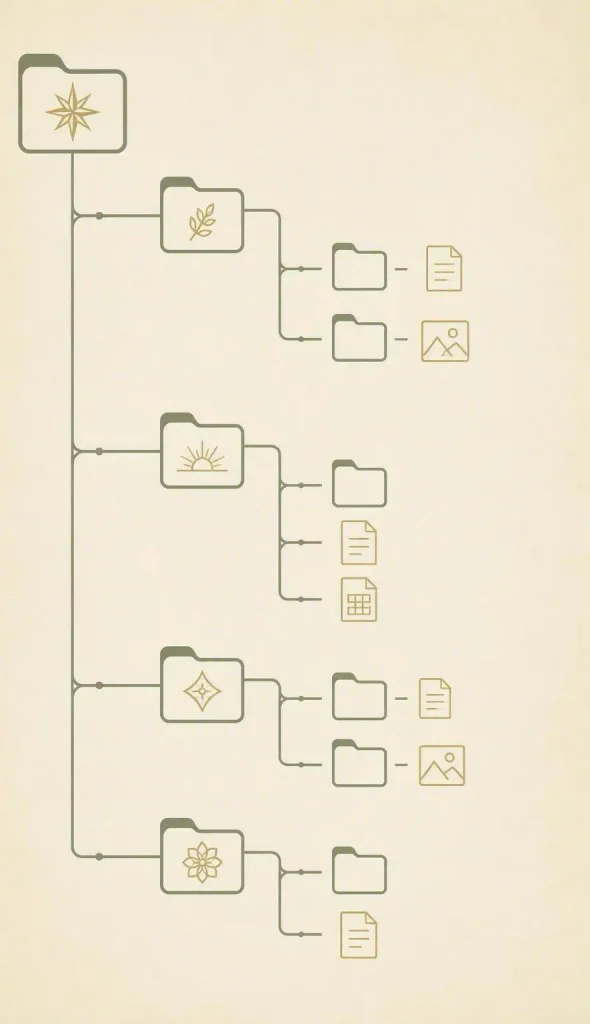
Here’s the structure I’m setting up:
Main Folder: 📁 Ancestral Archive
Inside it:
- 📁 By Surname
- 📁 By Document Type
- 📁 Photos
- 📁 Letters & Diaries
- 📁 Research Notes
- 📁 Unsorted (AI Review)
Every file will get a simple naming convention: Surname_FirstName_DocumentType_Year
Nothing fancy. Just consistent.
This makes AI processing dramatically easier later.
Step 4: Using AI to Make Sense of the Archive
This is where the Late‑Summer Lineage Reset becomes exciting.
AI can:
- Read handwritten letters
- Extract names, dates, and locations
- Identify relationships
- Recognize document types
- Flag duplicates
- Suggest connections
- Spot inconsistencies
- Highlight “interesting” or unusual details
- Build a spreadsheet of everything inside your archive
It’s like having a second pair of eyes — one that never gets tired and never overlooks a detail.
I’m planning to run each scanned document through an AI workflow that will:
- Transcribe the text
- Identify the people mentioned
- Extract genealogical metadata
- Suggest which family line it belongs to
- Add it to a master spreadsheet
- Flag anything that looks like a hidden gem
And honestly? I’m excited for the gems.
Because every archive has them — the overlooked note, the unexpected name, the detail that changes everything.
Step 5: Finding the Jewels You Missed
This is my favorite part.
AI is incredibly good at noticing:
- A surname spelled differently
- A location that appears only once
- A witness on a marriage certificate who shows up again in a census
- A neighbor who later marries into the family
- A date that doesn’t match the family story
- A handwritten note that hints at a migration
- A middle name that reveals a maternal line
These are the jewels — the tiny details that open new doors.
Late summer is the perfect time to find them. It’s a season of transition, of reflection, of preparing for the deeper research months ahead.
And with an archivist preserving your materials and AI illuminating them, you’re not just organizing your lineage — you’re resetting it. Refreshing it. Preparing it for the next chapter.
A Reset for the Season Ahead
This archive project feels like a gift — a chance to honor the past while preparing for the future. As the scans come in and the AI begins its work, I’ll share more of the discoveries, surprises, and insights that emerge.
For now, I’m simply grateful for the pause. For the reset. For the chance to see my lineage with new eyes.
And for the next chapter — the one I get to choose.
MORE AI TOOLS IN THE ANCESTRAL MIRROR

0 Comments