
My father once asked me if there was anything I wanted from him after he was gone. I am pretty sure he was gently trying to steer me toward my mother’s china collection — beautiful, carefully stored dishes that had been treated like tiny porcelain royalty since their wedding day.
But I did not hesitate. Not for a second. “I want the photographs,” I told him. And honestly? That is still my answer. Give me the shoeboxes. Give me the envelopes with someone’s fading handwriting on the front. Give me the blurry snapshots, the serious portraits, the mystery babies, the squinting cousins, and the random man in a hat nobody can identify but everyone insists “must be somebody important.”
In a world where we take photos by the dozen before breakfast, it is easy to forget that our ancestors sometimes left behind only one or two images for an entire lifetime. One photograph may be all we have of a great-grandmother’s face, a grandfather’s posture, or the house where a family story began. That makes every photo feel like a little doorway — and sometimes, like a dare: “Look closer.”
The Photo Box Is a Family Time Machine
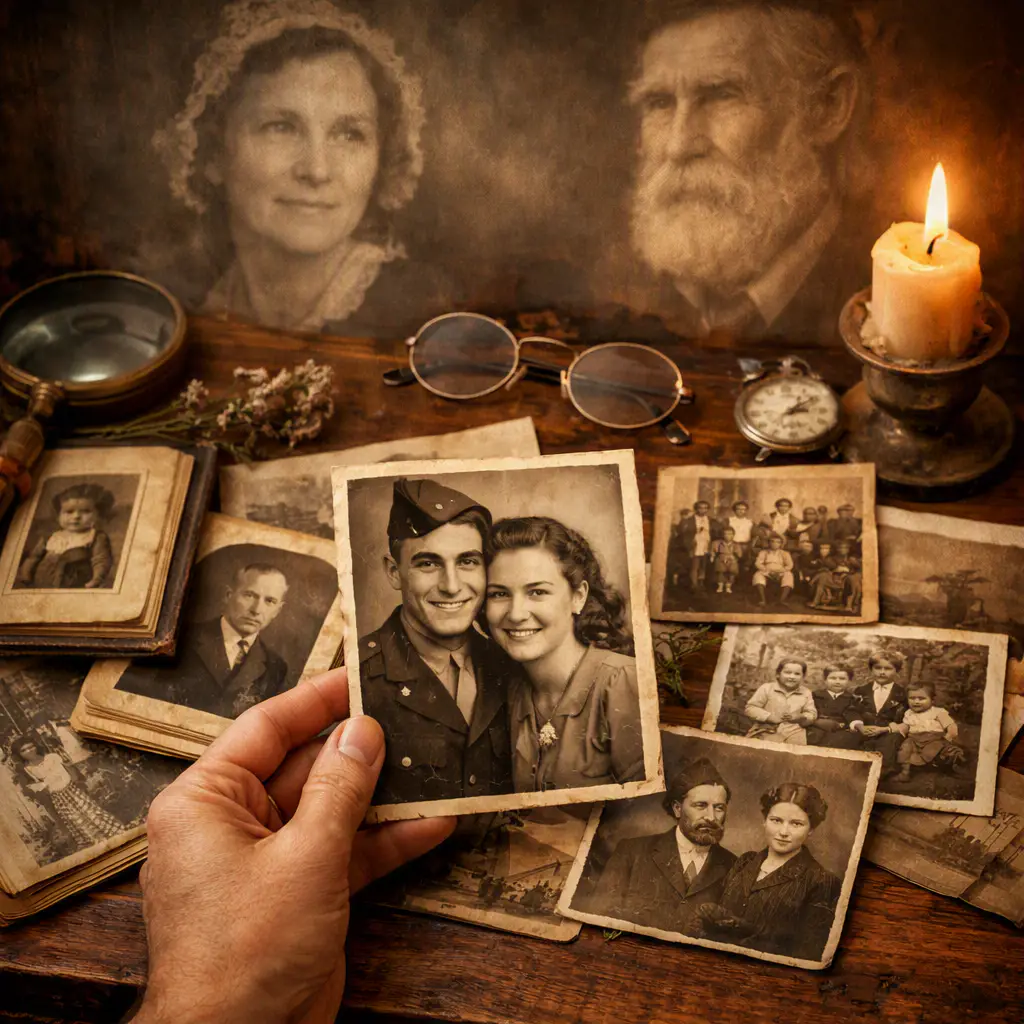
Old family photographs do more than show us faces and outfits. They preserve habits. Who stood next to whom. Who held the babies. Who hovered in the doorway. Who always had flour on her apron, a cigarette in his hand, or a child attached to one hip. They capture the family stage play before anyone thought to write down the script.
This is where AI becomes unexpectedly useful — not as the keeper of truth, but as the helpful assistant who will happily sort through a mountain of images without needing coffee, snacks, or a dramatic sigh. Current genealogy discussions emphasize that AI is best used as an assistant: it can restore photos, group faces, transcribe records, and surface clues, but human judgment still matters most.
Think of it this way: I bring the memories, suspicions, family lore, and occasional “Wait, why is Uncle So-and-So wearing a sailor suit?” energy. AI brings pattern recognition. Together, we can see things in old photos that might otherwise stay hidden in plain sight.
First, Digitize the Treasures
AI cannot peek inside a shoebox, no matter how smart it gets, so the first step is still wonderfully old-fashioned: gather the photos and scan them. I like to imagine this as inviting the ancestors to step out of the closet and into the light. Scan the front, scan the back, and do not ignore the notes, dates, studio stamps, or mysterious arrows someone drew in blue ballpoint pen in 1973.
Make a working copy, keep your originals safe, and back everything up. The goal is not to turn family history into a tech project. The goal is to give yourself a clean, searchable archive where the stories have room to breathe.
Let AI Sort the Crowd
Once your photos are digital, photo tools can begin grouping faces, recognizing similar people across different decades, and helping you find recurring settings. It is not magic, and it is certainly not perfect. But it is handy. Suddenly, the little girl in the 1918 porch photo might resemble the young woman in the wedding portrait. The man at the picnic might show up again in a work uniform. A house, church, kitchen, or painted backdrop may appear over and over like a recurring character.
That is when the fun begins. You are not just identifying people. You are noticing patterns: who always stands in the center, who is tucked at the edge, who appears at celebrations, who shows up only in work clothes, and who seems to be missing from the family album altogether.
Ask Better Questions
The best part of using AI with family photos is not that it gives you answers. It helps you ask better questions. Why is this child always photographed with that aunt? Why does this side of the family gather around tables while the other side poses on porches? Why are certain relatives always dressed for work, even at family events? Why does one branch preserve formal portraits while another leaves behind wild little snapshots full of motion and mischief?
These questions matter because photographs are emotional documents. They show us what people wanted remembered — and sometimes what they could not hide. A tilted shoulder, a protective hand, a familiar kitchen, a repeated absence. These are not just visual clues. They are echoes.
Keep the Humans in the Frame
A quick word of caution, because every good family historian needs one foot in wonder and one foot in common sense: be careful with privacy. If your photos include living relatives, think before uploading them to online tools. Use services with clear privacy policies when you can, and never let an AI guess replace evidence, records, or family knowledge.
AI can point and whisper, “Look over here.” You still decide what the clue means. You still bring the family stories, the documents, the instincts, and the heart.
Behind the Mirror
That is what I love about this work, and what lives at the heart of The Ancestral Mirror. We are not just collecting names and dates. We are looking for the patterns that shaped us — the visible ones, the hidden ones, and the ones waiting patiently in a photograph no one has examined closely in years.
So if you have a box of old family photos, do not wait for a rainy day that may never come. Open the box. Scan a few. Pick one face. Follow one clue. Let technology do a little of the sorting, then let your own curiosity do the rest.
Because sometimes the ancestors are not hiding. Sometimes they are right there, looking back at us, waiting for us to notice.
0 Comments