
The questions records cannot answer
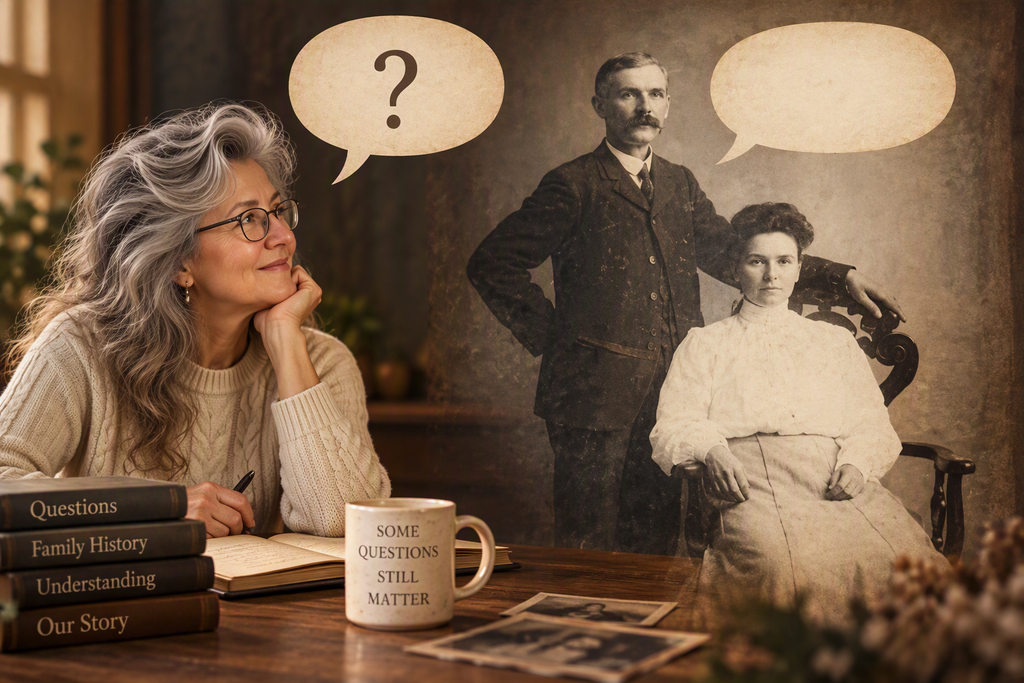
If you could sit across from one ancestor for an hour, who would you choose—and what would you ask?
Not the entire family gathered around a wonderfully improbable reunion table. Just one person. One chair pulled close. Enough time for a conversation, but probably not enough time for everything.
Would you choose the woman whose maiden name has resisted every search? The grandfather who never spoke about his childhood? The ancestor who appeared in a new place with a different surname and very little explanation?
And once that person settled into the chair, would your first question be the one you had planned?
That is the invitation behind this reflection: to move beyond choosing an ancestor and consider what we actually want from the encounter. A missing fact? An explanation? Perhaps a better understanding of someone whose choices still echo through our family story.
After 35 years of working on family history, I can imagine arriving at that table with a notebook full of practical questions. Names. Places. Relationships. A few mysteries that have consumed far more evenings than I care to count.
But I also wonder how quickly I would put the notebook down.
Because somewhere between “Who were your parents?” and “Why did you leave?” genealogy becomes something more than filling in the blanks.
It becomes an effort to understand a life.
Start with the person who keeps drawing you back
For this exercise, choose one ancestor—not necessarily the oldest, most mysterious, or most accomplished.
Choose the person you keep returning to.
Perhaps you have researched that person thoroughly but still feel that something important is missing. Perhaps you have only a name and a handful of dates. Or perhaps the records are plentiful, but the family’s explanation of those records has never quite made sense to you.
Write the person’s name at the top of a page. Underneath it, finish this sentence:
If I could speak with you, the thing I most want to understand is…
Try not to polish your answer. This is not your opening paragraph for a published family history. It is a private starting point.
You might write:
- Why did you leave your children with your sister?
- What made you cross an ocean without your family?
- Why did you stop using your original surname?
- What happened between you and your brother?
- What would you want us to know that nobody thought to preserve?
Or your question might be wonderfully ordinary:
What made you laugh?
There is room for that, too. We do not have to approach every ancestor through the most painful event in the record.
Make room for facts and understanding
Of course I would ask about a missing maiden name. I am still a genealogist.
There is nothing shallow about wanting accurate names, dates, and relationships. Those details help us distinguish one person from another and build a family history we can explain rather than merely repeat.
But for this conversation on paper, make two short lists.
On the first, write the factual questions you would ask:
- Where were you born?
- What was your mother’s name before marriage?
- Were you related to the family living next door?
- Where did you go between these two appearances in the records?
On the second, write the human questions:
- What did you hope would happen when you moved?
- What were you afraid of losing?
- Who helped you when things became difficult?
- What do you wish your children had understood?
Notice the difference.
“Where did you go?” asks for information.
“What were you hoping to find there?” asks for perspective.
Neither question replaces the other. Together, they help us identify both the research problem and the human concern beneath it.
For this exercise, choose one question from each list. Keeping the scope small will make it easier to move from reflection to useful research.
Notice what your question means to you
Now turn the page toward yourself for a moment.
Why this ancestor? Why this question?
The answer does not have to be profound. Sometimes an unresolved name is simply an unresolved name, and we would very much like to finish that branch.
But sometimes the question carries something personal.
An ancestor who left may interest us because leaving has been a difficult subject in our own lives. A woman whose work went unrecorded may draw our attention because we know what it feels like to be overlooked. A family rupture may trouble us because we are trying to understand what belonging means.
Personally, coming from a family full of storytellers, I’d love to hear some of our history “from the horse’s mouth.” It isn’t necessarily that I doubt the stories I inherited. I want the details. I want to hear enough about an event to see the world around it, not just the version that survived long enough to reach me.
These are possibilities to reflect on, not conclusions to impose.
Write a second sentence beneath your opening question:
This matters to me because…
You do not need to share what follows.
The purpose is to recognize what you bring to the research. If I desperately want an ancestor to have been courageous, misunderstood, or unfairly judged, I need to notice that wish before it begins choosing the explanation for me.
My feelings can guide the questions I ask. They cannot supply the ancestor’s answers.
Replace the verdict with a question
An imagined conversation can become an interrogation surprisingly quickly.
“Why did you abandon your family?”
“Why did you lie about your name?”
“Why didn’t you stand up for yourself?”
Each question contains a conclusion before the ancestor has had a chance to speak.
Try rewriting the question so that it leaves room for information you do not have.
Instead of:
Why did you abandon your children?
Try:
What circumstances led to your children living in another household?
Instead of:
Why did you hide your past?
Try:
What can I learn about the change in your name and the life you were building?
Instead of:
Why did you stay?
Try:
What options did you believe were available to you?
This is not an exercise in excusing harm. We can acknowledge the consequences of someone’s actions without pretending we know everything that shaped those actions.
The point is to begin with a question that can still be answered in more than one way.
Build a story map: what you know beside what you wonder
Your outline suggests placing known facts on one side and unanswered human questions on the other. That gives this imagined conversation a practical structure: a story map that keeps evidence visible while making room for curiosity.
Divide a page into two columns.
Label the left side What I can document.
Label the right side What I want to understand.
For a fictional example, imagine researching an ancestor named Marian. One census places her with her husband and children. A later census places the children with an aunt, while Marian appears elsewhere.
Your page might look like this:
| What I can document | What I want to understand |
| Marian and the children appear in the same household in an earlier census. | What changed after that enumeration? |
| The children appear in their aunt’s household in a later census. | Was this arrangement temporary, necessary, or intended to be permanent? |
| Marian appears in a different town. | What brought her there, and did she remain in contact with the children? |
| A family account says she “went away.” | Who used that phrase, and what did they actually know? |
Notice what the map does not say.
It does not say Marian abandoned her children. It does not say she made a loving sacrifice. Either statement would move beyond the information in this fictional example.
The map holds the question open.
Under the table, add three working labels:
- Documented: information supported by a source you can identify.
- Reported: something remembered or repeated by someone whose account you can attribute.
- Possible: an explanation you are considering but have not established.
These are labels for this worksheet, not substitutes for evaluating the sources themselves. Their purpose is to keep “perhaps” from quietly turning into “therefore.”
Put a source note beside each documented or reported item. Make it detailed enough that you—or another family researcher—can find the material again.
Ask what surrounded the decision
Once the map is in place, choose one unanswered question and work outward from it.
The outline offers several useful directions: available choices, pressures, historical circumstances, family memories, and family omissions.
Here is how I would turn those into a manageable research session.
What choices were available?
List the alternatives your ancestor might have had, and mark those you have investigated.
For Marian, “She could have taken the children with her” is a possibility to examine, not an assumption. What do we know about her housing, income, health, or household at the time?
Ask not “What would I have done?” but “What can I establish about the choices this person faced?”
What pressures might have mattered?
List possible pressures—employment, illness, debt, a death in the household, conflict, caregiving, or an unexplained relationship—without treating them as facts.
Ask what evidence could test each possibility. This turns “Times must have been hard” into a focused research question.
What was happening in that place and time?
Start with a place and date range. Instead of searching broadly for “women’s lives in the past,” focus on your ancestor’s location and circumstances.
Keep community context separate from personal evidence: it can guide your research, but cannot establish why your ancestor acted.
What did the family remember—or leave unsaid?
Write down the family’s wording as accurately as you can, and identify who told you.
Then ask:
- Did the storyteller witness the event?
- Were they repeating someone else’s account?
- How old were they when it happened?
- Have I heard a different version from another branch?
- What part of the story remains unexplained?
Treat an omission as a question, not an automatic discovery of secrecy.
“We have no explanation” and “They deliberately concealed it” are different statements. Your worksheet should preserve that difference.
Write the conversation without inventing testimony
Now return to the chair across from you.
Write a short letter to your ancestor using three beginnings:
Here is what I know.
Here is what I do not understand.
Here is what I wish I could ask you.
For Marian, it might read:
Marian, I can place you and your children together in one record and apart in another. I have heard that you “went away,” but I do not know where that description began.
I want to understand what happened between those points. I want to know who helped you, what you hoped would happen, and whether the arrangement turned out as you expected.
I also recognize that I have been calling this abandonment without knowing enough to use that word.
That is a meaningful conversation on paper, even though only one person is speaking.
I would resist writing Marian’s response as though I had recovered her voice. If you choose to write an imagined reply as a creative exercise, label it unmistakably as fiction or personal reflection and keep it separate from your research notes.
We can imagine possibilities without presenting them as testimony.
Leave yourself one useful next step
Before putting the page away, choose one action that follows from your map.
Not “solve Marian’s life.” Something smaller.
Identify the source of the family account. Examine a record you have only seen as an index entry. Build a timeline for the years between the two households. Investigate the aunt’s household alongside Marian’s.
Write the task at the bottom of the page:
My next research step is…
Then add one final sentence:
What I may have to leave unanswered is…
That second line matters. An exercise like this does not promise access to an ancestor’s private thoughts. It helps us become clearer about what we know, what we hope to learn, and where our own interpretation begins.
The word I would keep beside me is curiosity.
Curiosity can ask for the maiden name and still make room for the person who carried it. It can examine a painful choice without rushing to defend or condemn. It can admit that a record has given us an event without giving us its meaning.
Perhaps we will never have that hour across the table.
But we can change the questions we bring to the next document.
And instead of asking only, “What happened to you?” we can begin asking, “What have I not yet understood?”
0 Comments