
A Deep Dive into Denyse Allen’s Latest Argument
In her recent Chronicle Makers video, Denyse Allen revisits a question that has hovered over the genealogy community since the AI boom of 2025: Do genealogists really need to use multiple AI models to get reliable results?
Her answer, delivered with her usual clarity and pragmatism, is surprisingly simple: No. Not anymore. Pick one model, learn it well, and let it become part of your workflow.
For a field that thrives on precision, pattern recognition, and careful cross‑checking, this is a provocative stance. But it’s also a timely one.
How Claude and ChatGPT Performed on a Genealogy Document
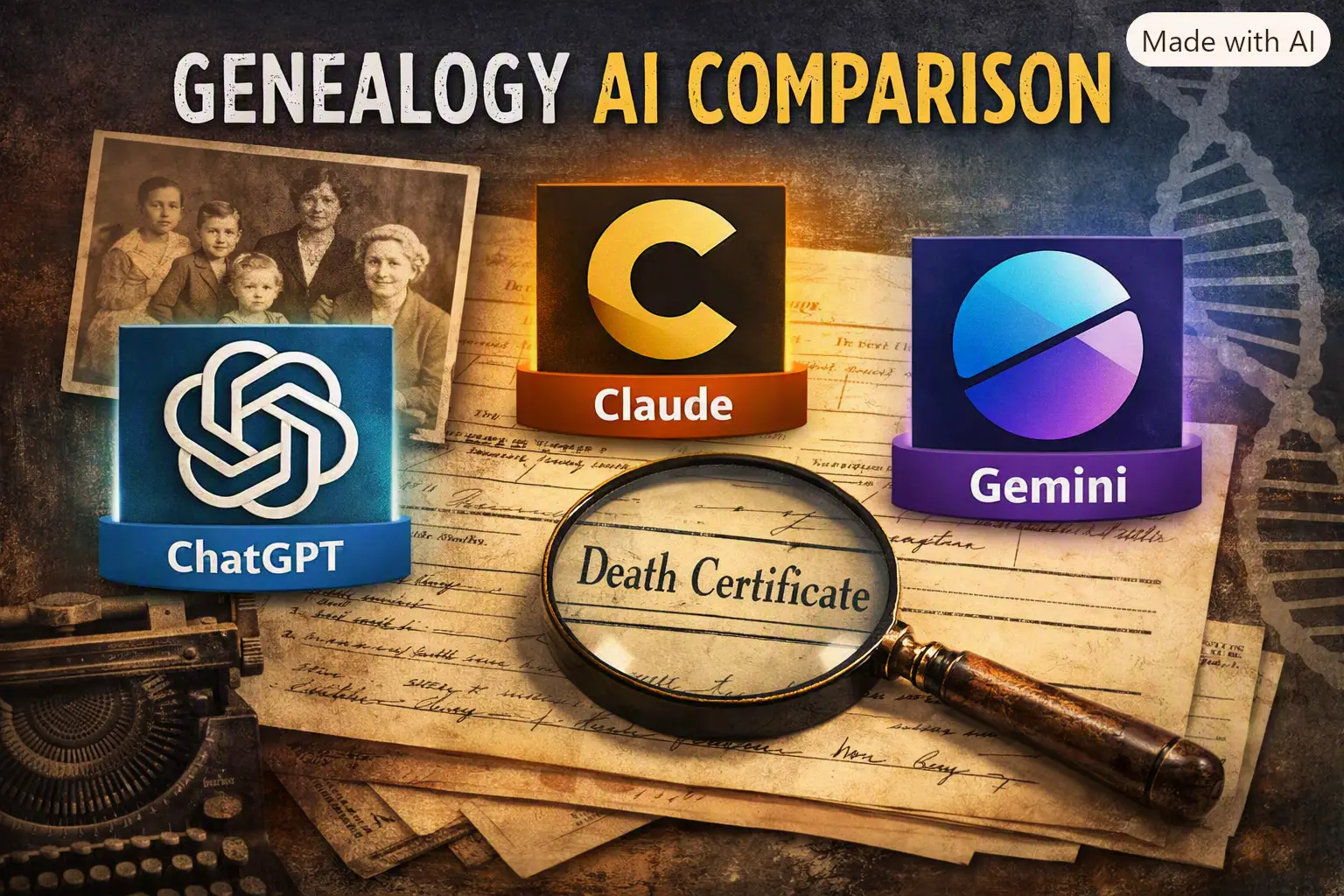
In the video, Denyse presents a death certificate — the kind genealogists know intimately: handwritten, imperfect, slightly smudged, and full of tiny details that matter. She asks both Claude and ChatGPT to:
- Transcribe the document
- Identify anything unusual or noteworthy
Both models perform the task with competence and consistency. No hallucinations. No dramatic differences. No need for elaborate prompt engineering.
Her conclusion is straightforward:
The major AI models have converged. Their differences are now subtle, not foundational.
This is a shift from the 2025 narrative, when genealogists were encouraged to use Claude for reasoning, ChatGPT for writing, Gemini for summarizing, and so on. Back then, each model had a distinct personality and skill set. Today, those distinctions have softened.
Where Denyse’s Argument Rings True
1. The performance gap has narrowed
The 2026 AI landscape is more stable. The leading models now share similar strengths: reliable transcription, solid summarization, and competent anomaly detection. For everyday genealogical tasks, the differences are negligible.
2. Workflow mastery matters more than tool variety
Genealogy rewards consistency. When you use one model regularly, you learn its tendencies — how it interprets handwriting, how it flags inconsistencies, how it handles ambiguous dates or surnames. That familiarity becomes part of your research intuition.
3. Switching models can introduce subtle bias
Each model has its own “voice.” Mixing them can create disjointed research notes or conflicting interpretations. A single model creates a unified analytical lens.
4. Most genealogical tasks are model‑agnostic
Transcribing a census record, summarizing a probate file, extracting surnames, or identifying informants — these tasks don’t require specialized AI personalities. They require clarity, consistency, and accuracy.
On these points, Denyse is absolutely right.
When Genealogists May Still Need More Than One AI Tool
While her argument is compelling, I think genealogists still benefit from model diversity—especially those working in complex or ambiguous research environments.
1. Difficult handwriting
In my view, especially difficult handwritten documents are one place where genealogists may still want to bring in a second tool. Claude can be useful when a record needs careful, structured reasoning around faint ink, inconsistent penmanship, or ambiguous letterforms, while Transkribus remains one of the strongest specialized platforms for handwriting recognition across older records, varied scripts, and documents that require trained transcription models.
2. Narrative writing
ChatGPT still has a more flexible storytelling voice, especially when genealogists want to craft ancestor biographies or interpretive narratives.
3. High‑stakes verification
When dealing with DNA triangulation, pedigree collapse, or conflicting evidence, cross‑checking with a second model can reduce error and increase confidence.
So while Denyse is correct that you can rely on one model, I know that when something is especially important to me, I like getting a second opinion — and in those moments, a second model can serve as ausefulsafety net.
Why Her Message Matters in 2026
The genealogy‑AI ecosystem is maturing. FamilySearch’s AI indexing has unlocked billions of previously inaccessible records. MyHeritage’s Scribe AI and Gaia tools are reshaping how genealogists interact with documents and timelines.
In this environment, the question is no longer:
“Which AI model is best?” but “How do I build a stable, repeatable workflow that helps me see patterns clearly?”
This is where Denyse’s advice aligns beautifully with the philosophy of Behind the Mirror.
The Behind the Mirror Perspective
The Ancestral Mirrorwork centers on the idea that genealogy is not just data collection — it’s pattern recognition across generations. It’s about seeing the echoes, the repetitions, the emotional and historical threads that weave through a family line.
A single, well‑understood AI model becomes a mirror you learn to read:
- You know how it interprets documents
- You know how it flags anomalies
- You know when it’s confident and when it’s guessing
- You know how to prompt it to reveal deeper patterns
Multiple models can feel like multiple mirrors — each reflecting slightly differently. One model, used well, becomes a trusted interpretive partner.
The Bottom Line
Denyse Allen’s message is a welcome simplification in a field that often feels overwhelmed by tools, platforms, and new technologies. Her argument encourages genealogists to focus on mastery, not model‑hopping — and that advice is both practical and empowering. I also feel this personally from a cost perspective: between Ancestry, resource websites, and all the small subscriptions that seem to pile up here and there, I would much rather pay for one AI model I know well and use the free plans of other models only when I need to cross‑check something important. Genealogy is becoming an expensive pursuit, especially for those of us who are “just” hobbyists and not professionals.
But the nuanced truth is this:
You don’t need multiple AI models. You may still want them for critical moments. And the real power lies in how you use the tools, not how many you use.
This is the kind of grounded, thoughtful conversation the genealogy community needs — and exactly the kind of insight Behind the Mirror is built to explore.
Author's Perspective
I am a hobbyist genealogist, not a professional researcher. Between Ancestry subscriptions, record collections, DNA services, and AI tools, genealogy costs can add up quickly. For that reason, I prefer maintaining one paid AI subscription and using other free AI models for occasional comparison and verification.
Frequently Asked Questions
Do genealogists need multiple AI models?
Not necessarily. In my experience, most genealogical tasks can be handled well by one AI model that you know thoroughly.
Which AI model is best for genealogy?
There is no single best model. Claude, ChatGPT, Gemini, and specialized tools such as Transkribus each have strengths depending on the task.
Can AI transcribe old handwritten records?
Yes, but difficult handwriting may require multiple tools and human verification.
Is genealogy becoming too expensive?
Many hobbyists feel the cost is increasing as subscriptions to genealogy databases, family history services, and AI tools add up.
0 Comments