

There is a quiet shift happening in the way people use technology, and most of us don’t have language for it yet. We talk about “using AI,” “prompting AI,” “asking AI questions,” or “getting AI to do something for us.” But beneath all of that is a deeper transformation — one that has less to do with tools and more to do with cognition.
When early readers of The Ancestral Mirror began sharing their reactions, one comment in particular stayed with me. A reader said:
“You’re not teaching people how to use AI. You’re teaching them how to think with AI.”
At the time, I nodded, grateful for the insight, but I didn’t fully grasp how important that distinction was. It wasn’t until I began writing about early reader reactions that the comment resurfaced — and this time, it struck me with full force.
Because they were right.
The book isn’t about tools. It isn’t about platforms. It isn’t about which AI model is “best.”
It’s about a way of thinking — a way of approaching your own mind, your own history, and your own patterns with a companion who can help you see what you’ve been unable to articulate.
This post is my attempt to explore that idea more deeply. What does it mean to think with AI? Why does it matter? And how does it change the way we approach genealogy, healing, and self‑understanding?
Let’s step behind the mirror.
1. Thinking With AI Begins With Slowing Down
Most people approach AI the same way they approach a search engine: fast, transactional, and outcome‑driven.
- “Give me the answer.”
- “Find the record.”
- “Tell me what this means.”
But AI is not a search engine. It’s a thought partner.
Thinking with AI requires a shift from speed to clarity. It asks you to slow down long enough to articulate:
- What you’re actually trying to understand
- Why it matters
- What you already know
- Where the gaps are
- What you suspect but haven’t said aloud
This is why the worksheets in The Ancestral Mirror come before the prompts. The writing slows you down. It forces you to externalize your thoughts. It gives the AI something meaningful to work with.
When you slow your thinking, the AI can deepen it.
2. Thinking With AI Means Externalizing Your Inner Logic
Most of us think in fragments. We carry half‑formed ideas, intuitive hunches, emotional echoes, and vague suspicions. We know something is there, but we can’t quite name it.
AI becomes powerful when you give it access to that internal landscape.
Thinking with AI means saying things like:
- “Here’s what I’m noticing…”
- “Here’s what feels connected, but I’m not sure why…”
- “Here’s the part I can’t make sense of…”
- “Here’s the pattern I think I’m seeing…”
When you externalize your inner logic, the AI can reflect it back to you with structure, clarity, and coherence.
It’s like having a second brain — one that can hold the entire pattern at once.
This is why so many early readers said the AI felt like a “secondary pair of eyes.” Not because it finds more data, but because it sees the architecture of your thinking.
3. Thinking With AI Is About Patterns, Not Prompts
People often assume AI is about crafting the perfect prompt. But the truth is far simpler and far more profound:
AI responds to the shape of your thinking, not the cleverness of your wording.
You don’t need fancy syntax. You don’t need technical jargon. You don’t need to “hack” the system.
You need to think in patterns.
This means asking questions like:
- “What connects these events across generations?”
- “What emotional signature repeats in this lineage?”
- “What is missing from this story, and why?”
- “What changed after this ancestor’s trauma?”
- “What assumptions am I making without realizing it?”
AI excels at pattern recognition. It sees echoes, gaps, and recurrences that humans overlook.
When you think in patterns, the AI amplifies them.
4. Thinking With AI Means Inviting It Into the Unknown
One of the most powerful things AI can do is illuminate the “unknown unknowns” — the things you didn’t realize you should be asking.
But it can only do that if you give it permission.
Thinking with AI means saying:
- “What am I not seeing?”
- “What questions should I be asking?”
- “What patterns might be present that I haven’t noticed?”
- “What would you explore next if you were me?”
This is where the magic happens.
This is where AI stops being a tool and becomes a guide.
This is where readers have said things like:
“It pointed out a migration pattern I had walked past a hundred times.”
or
“It showed me the emotional echo I inherited without realizing it.”
Thinking with AI means being willing to be surprised.
5. Thinking With AI Means Letting It Challenge You
AI is not here to flatter you. It’s not here to confirm your assumptions. It’s not here to protect your family myths.
It’s here to reflect the truth of the pattern.
Thinking with AI means being open to:
- contradictions
- alternative interpretations
- uncomfortable insights
- emotional revelations
- historical shadows
This is why therapists and clinicians have responded so strongly to the book. They recognize that AI, when used correctly, becomes a mirror — one that reflects without judgment.
One therapist wrote that the book provides “a safe space for the reader to confront their own shadows.” Another said it offers “a vocabulary for healing.”
Thinking with AI means letting it show you what you’ve been avoiding.
There’s one more practice I’ve come to rely on, especially when an AI gives me an answer that feels too neat, too confident, or too quickly resolved. After the initial response, I ask a simple follow‑up question: “What if you’re wrong?” That single prompt cracks the surface. It forces the AI to widen its lens, reveal its assumptions, surface alternative interpretations, and cite sources or uncertainties it glossed over the first time. It’s astonishing how much depth appears when you invite the model to challenge itself. Instead of accepting the first answer — which is often the most generic — you get nuance, context, and a fuller map of the terrain. It’s less about doubting the AI and more about expanding the conversation.
6. Thinking With AI Means Using It as a Lens, Not a Crutch
AI is not meant to replace your intuition. It’s meant to refine it.
Thinking with AI means:
- You bring the insight.
- You bring the emotional intelligence.
- You bring the lived experience.
- You bring the ancestral context.
AI brings:
- structure
- clarity
- pattern recognition
- synthesis
- perspective
Together, you create something neither of you could produce alone.
This is why so many readers have said the book feels like a “three‑way conversation between you, your ancestors, and a data analyst.”
Thinking with AI is collaborative, not passive.
7. Thinking With AI Means Understanding That Better Input Creates Better Insight
This is the part most people never learn.
AI doesn’t give you better answers. It gives you better versions of your own thinking.
When you:
- clarify your intention
- articulate your assumptions
- define the emotional or historical lens
- share your uncertainties
- name the pattern you’re exploring
…the AI can respond with depth, nuance, and precision.
When you give it vague, shallow, or rushed input, it mirrors that too.
Thinking with AI means treating the conversation as a craft.
8. Thinking With AI Means Seeing It as a Mirror
This is the heart of the Mirror Method.
AI reflects:
- your patterns
- your blind spots
- your emotional echoes
- your inherited narratives
- your unspoken questions
It doesn’t replace your thinking. It reveals it.
This is why the book resonates with genealogists, therapists, researchers, and truth‑seekers alike. They recognize that AI is not just a tool — it’s a reflective surface.
Thinking with AI means being willing to look into that mirror.
9. Thinking With AI Means Letting It Expand Your Imagination
AI is not here to limit you. It’s here to widen the horizon of what you can see.
Thinking with AI means asking:
- “What else is possible?”
- “What other interpretations exist?”
- “What might this mean in a larger context?”
- “How might this pattern evolve across generations?”
AI helps you imagine beyond the boundaries of your own mind.
It helps you see the story behind the story.
It helps you understand your lineage not just as a sequence of events, but as a living, breathing system.
10. Thinking With AI Is a Skill — and a Practice
This is the part that excites me most.
Thinking with AI is not a technical skill. It’s a cognitive one.
It’s a way of approaching:
- your history
- your identity
- your research
- your healing
- your questions
- your patterns
…with curiosity, clarity, and courage.
It’s a practice — one that deepens over time.
And it’s accessible to anyone, regardless of technical ability.
This is why the book is platform‑independent. This is why the prompts are conceptual, not mechanical. This is why the worksheets come first. This is why the method feels timeless.
Thinking with AI is not about the tool. It’s about the mind using it.
Why This Matters Now
We are living in a moment where technology is evolving faster than our language for it. People feel overwhelmed, intimidated, or unsure how to begin.
But the truth is simple:
You don’t need to learn how to use AI. You need to learn how to think with it.
And when you do, everything changes:
- Your research becomes deeper.
- Your insights become clearer.
- Your patterns become visible.
- Your healing becomes possible.
- Your lineage becomes illuminated.
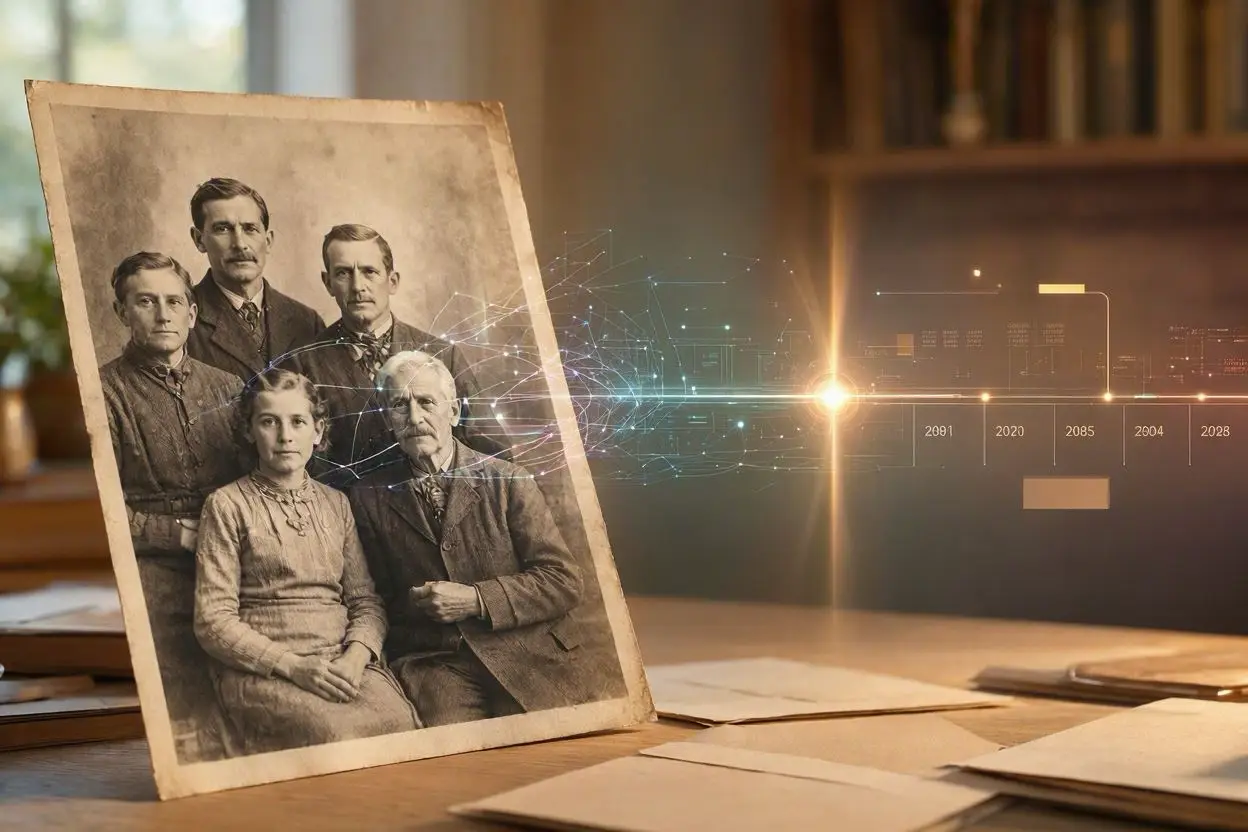
This is the future of genealogy. This is the future of self‑inquiry. This is the future of emotional cartography.
Not AI as a tool. AI as a companion in thought.



A Final Reflection
When that early reader said, “You’re teaching people how to think with AI,” I didn’t realize how true it was.
But now I see it clearly.
This is the work. This is the method. This is the mirror.
AI doesn’t replace your thinking. It expands it. It clarifies it. It reflects it. It deepens it. It challenges it. It honors it.
And when you learn to think with AI, you learn to see yourself — and your ancestors — with new eyes.
The mirror becomes clearer. The patterns become visible. The story becomes whole.
And you become the author of the next chapter.



0 Comments